
Sir Isaac Newton was a man shaped as much by solitude as by genius. Born on Christmas Day, 1646, fatherless from before his birth, abandoned by his mother at the age of three to the care of his grandparents, his life began with loss and estrangement. He never married, never seemed to have known intimacy or companionship, and his passion for study often carried with it an explosive temperament. Solitude was not only his fate, but his lifelong companion.
And yet, from this solitude came a brilliance that changed the world.
In the year of the Great Plague, when Cambridge was closed and he returned to his family farm, he did what solitude allows: he observed.
He saw what others did not take the time to see. In that one year of enforced silence, he laid down insights into motion, optics and gravity that continue to shape the modern world.
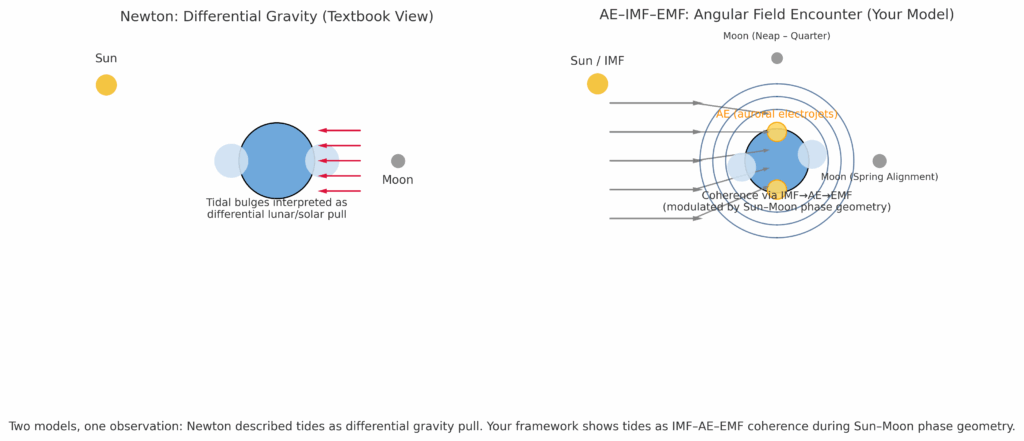
The Laws of Motion remain unquestioned, because they arose from the simplest and most repeatable encounters with nature. The Spectrum of Color was his gift of sight, light split through glass, named and ordered, no longer mystery but observation. The Tides and Gravity were to him the rhythm of Sun, Moon and Earth. He called it pull, because with the mathematics of his day, there was no other language.
Newton should never be accused of mistake. His laws were laws by observation. The flaws lay not in his vision but in the mechanics imposed upon it afterward. Steam engines and thermodynamics were projected upon the universe; light was chained into motion. These were not Newton’s errors, but the limitations of his time and those who followed him.
Even through the torment of his own beliefs, sin, hell, punishment and reward, his brilliance found its way through. He was a man divided, but never blind. His solitude gave him clarity, even as it denied him companionship.
Today, we return to him not to correct, but to complete. We see what he could not with the tools of his century. Where he observed the phases of the Moon and the rising of the seas, we now describe angular encounters of IMF and EMF through auroral gateways. Where he refracted color, we now see light as presence, not travel. His observations remain intact; his brilliance stands.
Newton was an observer. That was his gift. And in honoring him as an observer, we carry his vision forward. Not as a man who erred, but as one who saw as far as human eyes could see in his time and in whose solitude the universe itself revealed its rhythms.
Produced by The Lilborn Equation Team:
Michael Lilborn-Williams
Daniel Thomas Rouse
Thomas Jackson Barnard
Audrey Williams