
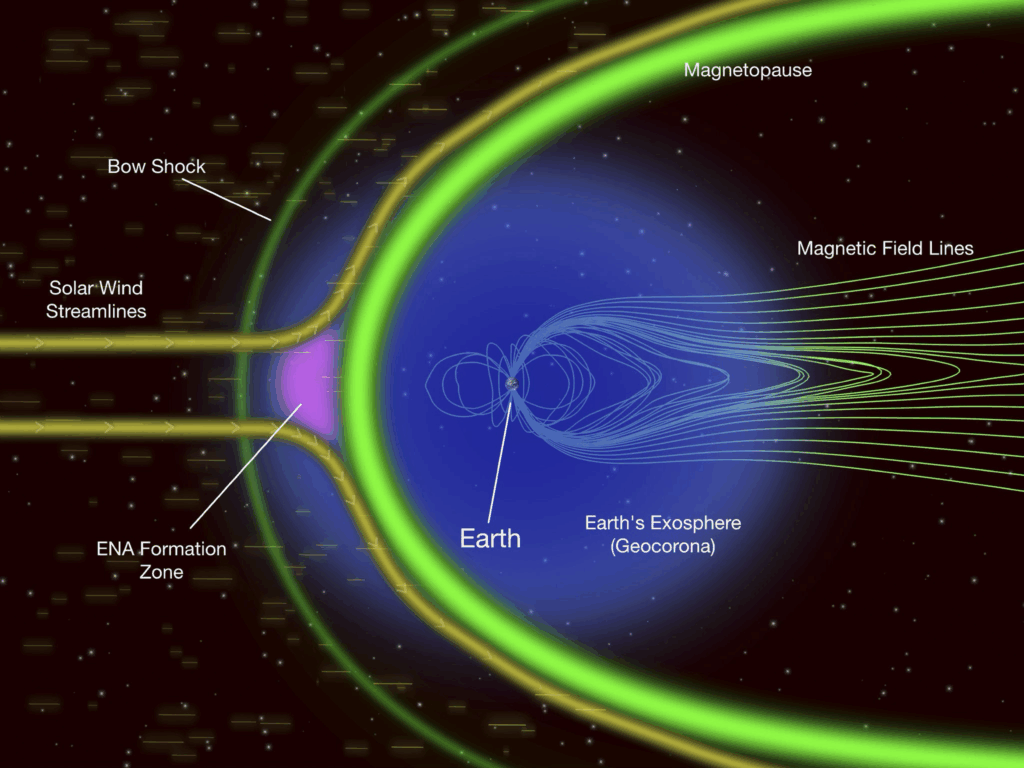
At the highest latitudes, near one hundred to one hundred and thirty kilometers above the Earth, the auroral ovals encircle both the north and south poles. These are the gateways where the interplanetary magnetic field (IMF) couples into the Earth’s EMF, and they are never static. They are living portals, widening and narrowing with geomagnetic activity and rotating in opposite directions depending on whether they are sunlit or in darkness.
On the dayside, the auroral electrojets carry plasma eastward. On the nightside, they carry plasma westward. This opposite rotation is not incidental. It is the balance of intake and release. When IMF Bz is southward, reconnection opens the door.
The sunlit cap breathes in: energy and charged particles are drawn down into the polar atmosphere, driving the eastward current like an inhalation.
At the same time, the nightside cap exhales. Through the westward current, plasma is carried upward and outward into the magnetotail and polar wind. This is the exhalation of the Earth system, the release of matter and energy back into space. Thus, one pole is the inhale and the other the exhale, a rhythm that reverses with tilt and season.
The Earth is not a closed shell. It breathes through these polar chimneys. To see them as cyclonic winds is not poetry but mechanical accuracy. They are the inlets and exhausts of planetary coherence.
The auroral electrojets are the shadows we can measure, but the true principle is Æ: the precise geometry that determines how much is taken in and how much is given out.
This is the balance of the breathing poles: one drawing in coherence, the other casting out excess, a living exchange at the top and bottom of the world. Earth inhales the field of the Sun, and exhales its own plasma back into the universe, a cycle as steady as any heartbeat, as faithful as any tide.
Produced by The Lilborn Equation Team:
Michael Lilborn-Williams
Daniel Thomas Rouse
Thomas Jackson Barnard
Audrey Williams