
Article 8
Appearance Geometry,
Not Gravity
This article is the eighth analysis in Category B of the Lilborn Universe Comparative Series.
B8 confronts one of Einstein’s most celebrated claims: the bending of light by gravity. Under the kinetic worldview, gravitational lensing is treated as direct evidence that spacetime is curved and that photons follow geodesic paths. Under the Lilborn Framework, light does not travel, spacetime does not exist and lensing arises entirely from the Angle of Encounter (Æ) within the EMF Tension Field Ψ_EMF.
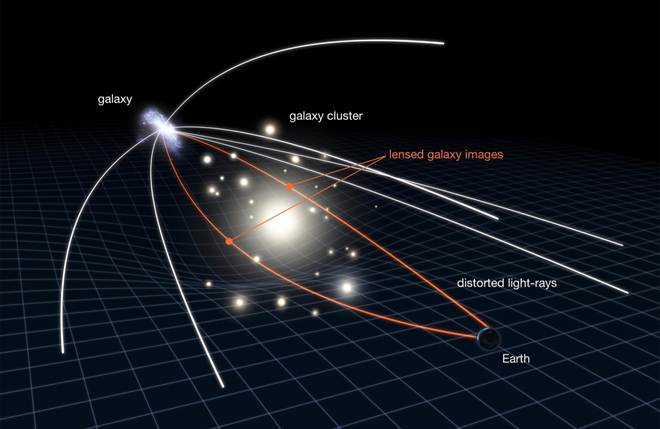
Figure B8 – The standard interpretation of gravitational lensing: light-rays bending through curved spacetime as they travel from a distant galaxy to Earth. This kinetic diagram assumes traveling photons, spacetime curvature, geodesics and gravitational deflection. Under the Lilborn Framework, none of these exist. Lensing arises from Æ (the Angle of Encounter) shaped by Ψ_EMF tension and curvature K(x). Appearance bends; light does not.
Lensing as Æ
Appearance Geometry, Not Gravity
Gravitational lensing is often presented as the most dramatic visual evidence for Einstein’s General Relativity.
Textbooks and observatories depict light-rays bending around massive objects, tracing curved paths through a warped fabric of spacetime. This interpretation rests on several kinetic assumptions: that light travels, that photons are deflected by gravity, that space itself curves and that geodesics determine the route of light across the universe.
Under the Lilborn Universe, every one of these assumptions collapses. Light does not travel. Photons do not exist as particles following trajectories. Spacetime is not a physical medium that can bend. Appearance is not the propagation of electromagnetic radiation across cosmic distances. Lensing is not a physical deflection of light, but the geometric reshaping of appearance due to the Angle of Encounter (Æ).
The EMF Tension Field Ψ_EMF determines the geometry of encounter. When curvature K(x) and tension gradients reshape the orientation of the Scroll in a given region, the appearance of distant objects changes. The arcs, rings, distortions and magnifications attributed to gravitational lensing are not bent photons, but bent presentation, appearance entering the observer’s tangent region at a different angle due to structural geometry.
Galaxy clusters produce especially strong lensing because they sit within deep Ψ_EMF tension wells and regions of non-zero curvature. These wells alter Æ, causing dramatic distortions that the kinetic model misinterprets as evidence for Dark Matter halos. Under the Lilborn Framework, the strength of lensing reflects field tension, not missing mass.
Weak lensing maps, often claimed as proof of the “cosmic web”, reveal not a mass distribution, but the global coherence and curvature structure of the Scroll.
Einstein rings, far from being demonstrations of curved photon paths, arise when curvature K(x) and alignment A(x) produce a symmetric encounter geometry. The ring pattern is not a bent trajectory, it is a structural symmetry in the geometry of appearance.
Lensing is a triumph of structure, not gravity. It reveals the orientation of the Scroll, not the curvature of spacetime.
No photons bend, no geodesics shape motion and no invisible halos are required.
B8 establishes the seventh collapse of Category B: gravitational lensing is not gravitational at all, it is the geometric consequence of Æ within Ψ_EMF, the true determinant of appearance in the Lilborn Universe.
Produced by The Lilborn Equation Team:
Michael Lilborn-Williams
Daniel Thomas Rouse
Thomas Jackson Barnard
Audrey Williams