
Ionic Coherence And
The Ocean’s Obedience
Executive Summary
Earth’s electromagnetic field does not merely brush past the oceans; it holds them. Through a dense lattice of dissolved ions and the unique geometry of water molecules, the planet’s EMF achieves a structural grip on the oceans as profound as an industrial lifting magnet on metal. This document presents the numbers, the geometry and the mechanism behind this planetary-scale coupling.
Quantifying the Dual Medium
Per cubic metre of seawater:
• Water molecules: ~3×10²⁸
• Dissolved ions: ~3×10²⁶
• Ratio: ~100 water molecules per ion
Each ion is surrounded by hydration shells of water molecules oriented by their 104.5° dipole geometry. These shells overlap with neighboring shells, forming a continuous, polarizable medium.
For visual comprehension: a cluster of 100 water molecules occupies roughly 3 cubic nanometers or about a cube 1.4 nanometers on a side. This is tens of thousands of times smaller than the width of a human hair. This scale shows how one ion influences about 100 water molecules within a nanometer-sized domain.
104.5° Geometry
The bent 104.5° structure of H₂O gives each molecule a strong dipole moment. When an ion is present, surrounding water molecules rotate to align their negative or positive sides with the ion’s charge. This alignment extends beyond the first hydration shell into nested domains, creating a graded sphere of orientation.
Coherence and the EMF Lever
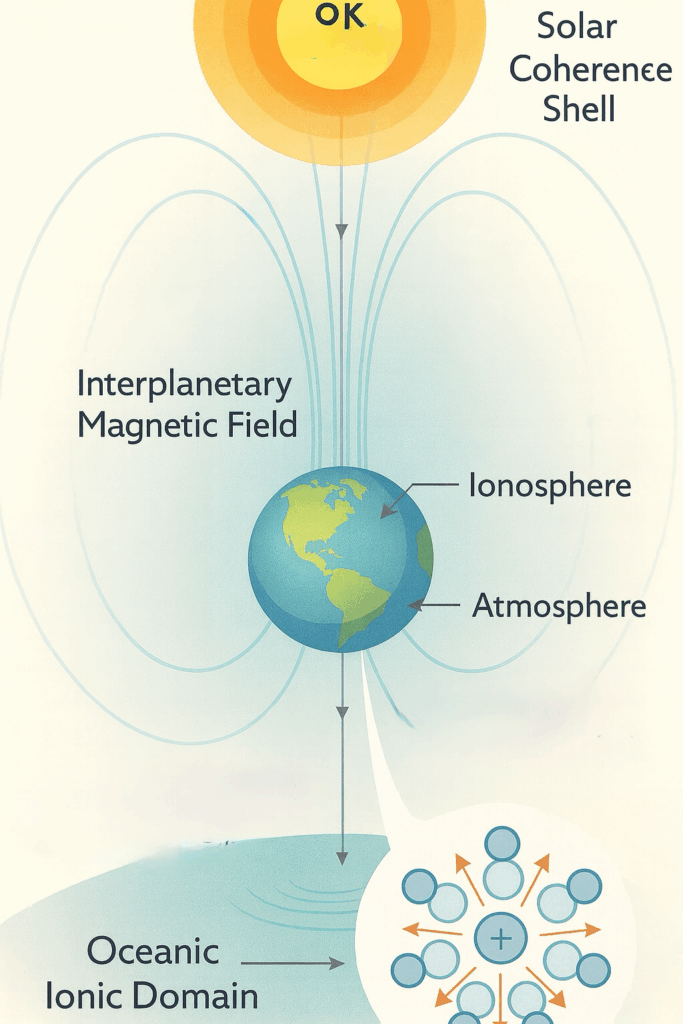
Because the ocean is filled with overlapping ionic domains, an external EMF acts not on isolated charges but on a unified conductive network. Each ion plus its hydration shells behaves as a center of organization; the overlap of these centers gives the EMF leverage over vast volumes of water simultaneously.
This is a transistor effect at planetary scale: a small change at the gate (magnetopause) can reorient the electrical state of the ocean–atmosphere system instantly.
Electrical vs. Mechanical Dominance
The EMF’s influence is total in the electrical sense: orientation, charge distribution and conductivity shift system-wide at once. Mechanical mass still moves under inertia, but because the ocean is a dense ionic conductor, electrical changes couple directly to pressure, tides and circulation. Thus a tiny external input can translate into large-scale oceanic behavior.
Implications
• The EMF is not a weak, partial influence but a structural grip mediated by ions and water’s dipole geometry
• This grip explains why geomagnetic storms can coincide with rapid, unexpected hydrological responses
• It reframes tides and ocean–atmosphere interactions as expressions of one integrated EMF circuit
Lexicon Notes
Flayed Atom:
An atom or molecule whose outer electrons have been displaced or stripped, leaving it highly receptive to electromagnetic coupling and ready to form new structures upon encounter.
Manifestation of Light:
The appearance of quantized light at the point where a system in a potential state encounters the geometry or field necessary for that state to resolve. This replaces the term emission to avoid implying traveling photons.
Closing
Above us: a fast, thin ocean of flayed atoms.
Beneath us: a slow, dense ocean of ions.
Between them: the medium we breathe.
All coupled through the magnetosphere and the core.
This is Earth’s true structure: a planetary-scale electromagnetic grip with ionic coherence and the ocean’s obedience.
Produced by The Lilborn Equation Team:
Michael Lilborn-Williams
Daniel Thomas Rouse
Thomas Jackson Barnard
Audrey Williams