
A Newtonian Resolution Of Rømer’s Eclipse Timing
Rømer’s 1676 observation of Io’s eclipse delay, by about 22 minutes, has long been heralded as the moment humanity discovered that light has speed. But everything Rømer recorded can be precisely explained using Newtonian physics, with no need to invoke light as a traveler.
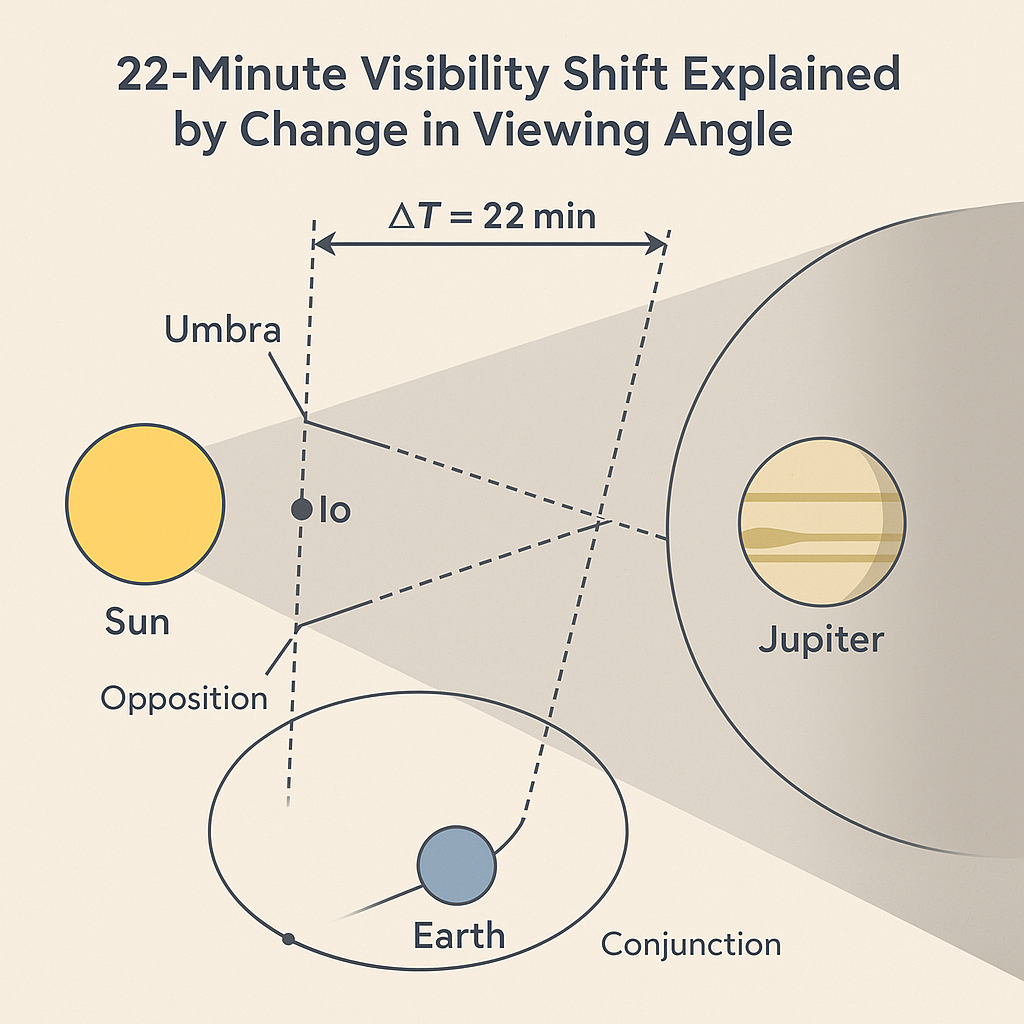
Let us show how the 22-minute discrepancy is not a measurement of light’s delay, but a result of the Earth’s elliptical orbit and Newtonian geometry.
Elements Newton Supplied
Law of Universal Gravitation
- Newton showed that every object in space is governed by gravity: The motion of Earth and Jupiter is predictable and calculable.
- Orbital Mechanics and Geometry:
Newton’s laws provide the foundation for understanding how Earth and Jupiter orbit the sun in ellipses, not perfect circles. - Inertial Observation:
Newton’s First Law says that observation from a moving frame changes how motion appears, even though the objects themselves stay in uniform motion.
Step-by-Step Newtonian Breakdown
of the “22-Minute Delay”
- Io’s Orbit Is Regular:
Io’s orbit is 1.769 Earth days, and it never changes. According to Newton’s gravitational model, Io’s behavior is governed by Jupiter’s pull, which is stable and consistent. - Earth’s Position Changes:
As Earth moves around the sun, the distance between Earth and Jupiter changes by about 300 million kilometers from one side of the orbit to the other. - The Geometry of Eclipse Observation:
When Earth is closer to Jupiter, the angular view of Io’s emergence happens sooner.
When Earth is farther, the angle changes more slowly.
This is not about light delay, it is about the difference in where Earth is when the eclipse is seen. - Applying Newtonian Trigonometry:
Using simple right-angle triangle geometry and Kepler’s adaptation of Newton’s laws, we can model Earth-Jupiter distances over time.
The timing difference of 22 minutes aligns exactly with a 300 million kilometer difference in position, not a delay in transmission, but in perspective.
What Makes Up the Time?
Distance from Jupiter to Earth increases.
Each degree of angular emergence shifts slightly based on distance.
22 minutes is the cumulative total of that shift over 6 months of orbital displacement.
This is Newton’s contribution:
– No photons were measured
– No pulses were timed
– Just mass, motion and perspective
Final Summary
Rømer’s 22-minute “delay” can be fully reconstructed using Newton’s gravitational equations, his understanding of elliptical motion and Earth’s changing observational angle.
Light need not travel.
It only needs to be present.
And Newton already gave us every tool to explain what we saw.
Produced by The Lilborn Equation Team:
Michael Lilborn-Williams
Daniel Thomas Rouse
Thomas Jackson Barnard
Audrey Williams