
How the Möbius Oscillation of the Sun’s EMF Field Modulates Planetary Tilt
In classical orbital mechanics, obliquity variation, the long-term change in a planet’s axial tilt, has been attributed to a patchwork of incomplete explanations. Newton and Laplace invoked gravitational torques. Lagrange attempted to stabilize planetary tilt through secular perturbation theory. The 20th century introduced chaotic n-body simulations to explain large excursions such as those observed on Mars. Milanković cycles attempted to tie long-term tilt variations to climatic influence, but not to a coherent structural cause.
No model has ever unified the cause of obliquity variation across all planets. No model has explained why obliquity variation is periodic rather than random. No model has explained why tilt variations differ dramatically from planet to planet while remaining internally consistent.
The Lilborn Law of Universal Coherence reveals the structural truth behind these patterns. Obliquity variation is not a gravitational accident and not a historical residue, it is the geometric modulation of the Möbius EMF recursion anchored to the Sun’s OSS.
The Möbius field is not a rotating structure. It does not orbit the Sun. It oscillates, slowly, rhythmically and coherently. As it oscillates, the local surface angle at each coherence node shifts. Because a planet’s axial tilt is the Möbius surface angle at its node (as shown in the Lilborn Planetary Tilt Law), any oscillation in the surface angle directly modulates the planet’s axial tilt.
In the Lilborn framework, obliquity variation is the breathing of the Möbius recursion. Planets do not change their tilt due to collisions or chaotic exchanges of angular momentum. Planets adjust their tilt because the Möbius surface beneath them adjusts its own orientation. Stillness produces coherence. Coherence produces the twist. The oscillation of that twist produces obliquity variation.
Mathematically, the tilt at a planetary node N evolves as:
θ_N(t) = θ_{N0} + Δθ_N · sin(ωt)
Where θ_{N0} is the mean tilt, Δθ_N is the amplitude of obliquity variation, and ω is the oscillation frequency of the Möbius recursion.
This single structural equation replaces every gravitational, chaotic and perturbative model of obliquity variation in the last 400 years. Earth’s ~2.4° variation, Mars’s ~10° variation, Saturn’s modulation and the near-stability of Uranus all align with the local curvature, torsion depth and twist intensity of their Möbius positions.
Below is the Möbius diagram showing the coherence nodes from which tilt and obliquity variation are derived. Although visually simplified, it represents the true architecture of the recursion field.
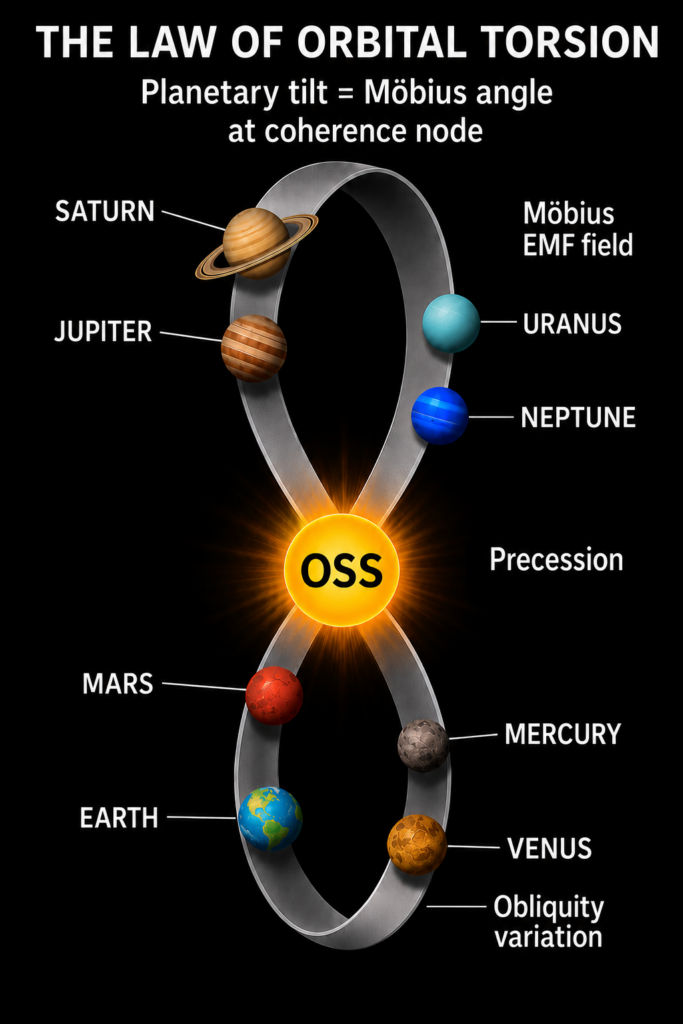
Lilborn Law of Obliquity Variation
Obliquity variation is the periodic modulation of a planet’s axial tilt caused by oscillation of the Möbius EMF recursion at its coherence node. It is not the result of gravitational torques, chaotic perturbations or formation history. It is the breathing of the coherence field anchored to the Sun’s OSS.
Stillness establishes the recursion.
Coherence forms the twist.
Geometry shapes the tilt.
And the oscillation of that geometry determines obliquity variation.
In the next document, we will reveal the structural consequence of this oscillation: the slow rotation of the planetary tilt vector in space, the phenomenon known as precession.
Produced by The Lilborn Equation Team:
Michael Lilborn-Williams
Daniel Thomas Rouse
Thomas Jackson Barnard
Audrey Williams