
Orbital Inclination as the Möbius Path Angle of the Sun’s EMF Recursion Field
Over four centuries, orbital inclination has been treated as an historical artifact, the accidental result of early impacts, gravitational perturbations or chaotic formation events. This framework, introduced by Johannes Kepler (1609), elaborated by Isaac Newton (1687), expanded by Pierre-Simon Laplace (1799) and insisted upon by modern perturbation theory, has failed to produce a unified cause for orbital inclination across the solar system.
The Newtonian model explains inclination as a tilt of each orbital plane caused by interplanetary gravitational forces. The Laplacian model explains it through early nebular asymmetries. The 20th-century n-body simulations describe inclination as an emergent chaotic parameter. General Relativity avoids the question entirely, offering no structural mechanism for inclination beyond geodesic motion in curved spacetime.
Every one of these explanations fragments under scrutiny. None explains why planets with vastly different masses, compositions, formation histories and orbital radii produce inclinations that fall into a narrow geometric pattern. None explains why inclination persists with stability over millions of years. None explains why inclination varies predictably rather than chaotically. None explains why every orbit in the solar system fails to remain planar over time.
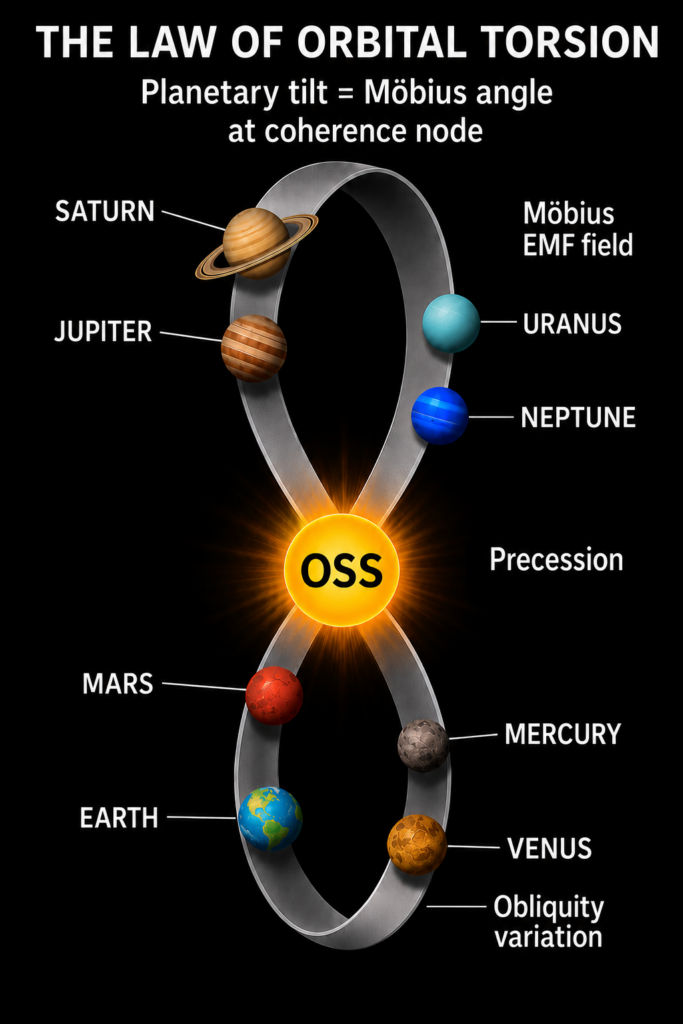
The Lilborn Law of Universal Coherence provides the first structural explanation of orbital inclination grounded not in motion, history or perturbation, but in geometry, the geometry of the Sun’s Möbius EMF recursion anchored to OSS. The Möbius recursion is not an orbiting structure. It is a stationary coherence surface that oscillates and twists around the Sun.
Every planet is fixed at a coherence node on this strip. Each node possesses a specific orientation: the local path angle of the Möbius surface relative to the OSS axis. This local path angle is what classical astronomy misinterpreted as “orbital inclination”. Inclination is not a tilt of space or an ancient accident, it is the Möbius path angle at the planet’s coherence node.
Tilt and inclination are distinct but related: tilt corresponds to the Möbius surface angle (the orientation of the strip itself), while inclination corresponds to the Möbius path angle (the orientation of the trajectory traced along that strip). The former gives the planet’s axial tilt; the latter defines its orbital inclination. Both emerge from the same underlying geometry.
Once inclination is understood as a geometric expression of the Möbius recursion, every anomaly collapses into coherence. Mercury’s ~7° inclination, Pluto’s ~17° and the subtle inclinations of Mars, Saturn and Neptune all resolve as functions of their positions along the recursion. No gravitational perturbation model has ever unified these values. The Möbius field does so immediately.
Below is the Möbius diagram used to anchor the structural mapping of tilt and inclination. In this document we focus on inclination, the angle of the path taken by each planet along the Möbius field.
Produced by The Lilborn Equation Team:
Michael Lilborn-Williams
Daniel Thomas Rouse
Thomas Jackson Barnard
Audrey Williams