
Axial Tilt As The Möbius Angle At Each Planet’s Coherence Node
Expressed Through Compliance
Introduction
Classical physics treats a planet’s axial tilt as a historical accident, the residue of collisions, chaotic formation or angular momentum exchanges during early solar evolution. This patchwork explanation fails to unify the entire spread of tilts across the solar system, from Mercury’s near-zero tilt to Uranus lying on its side, to Venus spinning nearly upside down.
The Lilborn Law of Universal Coherence provides the first structural explanation of planetary tilt based on the geometry of the Sun’s Möbius EMF recursion anchored to OSS. The Möbius recursion does not orbit the Sun. It oscillates, twists and maintains a single continuous surface. Every planet resolves its identity along this surface at a fixed coherence node. Each coherence node has a specific geometric angle: the Möbius twist at that position.
A planet’s axial tilt is the bodily expression of the Möbius angle at its coherence node. Tilt is not historical accident. Tilt is structural compliance with the local geometry of the recursion.
Two Distinct Quantities
Structural Angle And Bodily Expression
Understanding this law requires holding two quantities separate that have often been conflated in earlier discussion.
Structural angle of the node: The Möbius twist angle at the position on the recursion where a planet’s identity resolves. This angle is set from creation and does not change. The coherence node’s position on the Möbius surface, and therefore the angle the Möbius expresses at that position, is a fixed structural fact about that planet.
Bodily expression of the angle: The actual physical tilt the planet’s body exhibits at a given moment. A planet’s body either expresses the structural angle of its node or stores torsion against it. The Möbius continuously rotates around the body; the body either complies with the local angle or accumulates stress until compliance occurs.
These two quantities are normally equal, because the long-term tendency of any body within the Möbius recursion is to comply with the geometry of its node. But they can diverge for a finite window. When they diverge, the body is in a torsion accumulation phase. When they converge, the body has complied.
The Möbius Position Does Not Change
A planet’s position on the Möbius recursion does not move. The coherence node is where the planet’s identity resolves along the recursion surface, and that resolution is structural rather than dynamic. Earth’s node has always been at the same place on the Möbius. Mercury’s node has always been at the same place. Venus’, Mars’, Jupiter’s, Saturn’s, Uranus’, Neptune’s, each fixed.
What can change, and what the framework has documented changing for Earth, is the body’s physical configuration relative to its node. The node holds its structural angle continuously. The body either expresses that angle or has not yet complied. The environment of the Möbius twists around the body whether the body has complied or not.
Earth’s node, in this reading, has always held an angle of approximately 23.5°. For the first 1656 years from creation, Earth’s body expressed 0°, accumulating torsion against the structural angle the node had been holding all along. At the compliance event, Earth’s body finally came into agreement with what its node had always been. The node did not move to 23.5°. The body finally caught up.
Mapping The Observed Tilts
To The Möbius Profile
Because a Möbius strip rotates 360° over one full loop, the twist angle ranges continuously from 0° to 360°. Each planet occupies a specific position on this recursion, and the local twist angle at that position is the structural angle of its node.
When the observed axial tilts of the planets are mapped to the twist profile of a Möbius, the alignment is exact:
– Mercury (~0°) sits on a nearly straight Möbius segment.
– Jupiter (~3°) lies on a shallow twist region.
– Earth (~23.5°), Mars (~25°), Saturn (~27°) and Neptune (~28°) occupy medium-twist nodes.
– Uranus (~98°) aligns with the Möbius’ first major inversion, the natural 90°–110° roll-over region.
– Venus (~177°) corresponds to the near-180° inversion node, the Möbius’ half-turn.
This geometric match is not approximate. It is exact. No chaotic model, collision hypothesis or thermal history can produce this unified structure. The match is exact because each observed tilt is the bodily expression of the structural angle the Möbius holds at that planet’s coherence node.
The Annotated Diagram
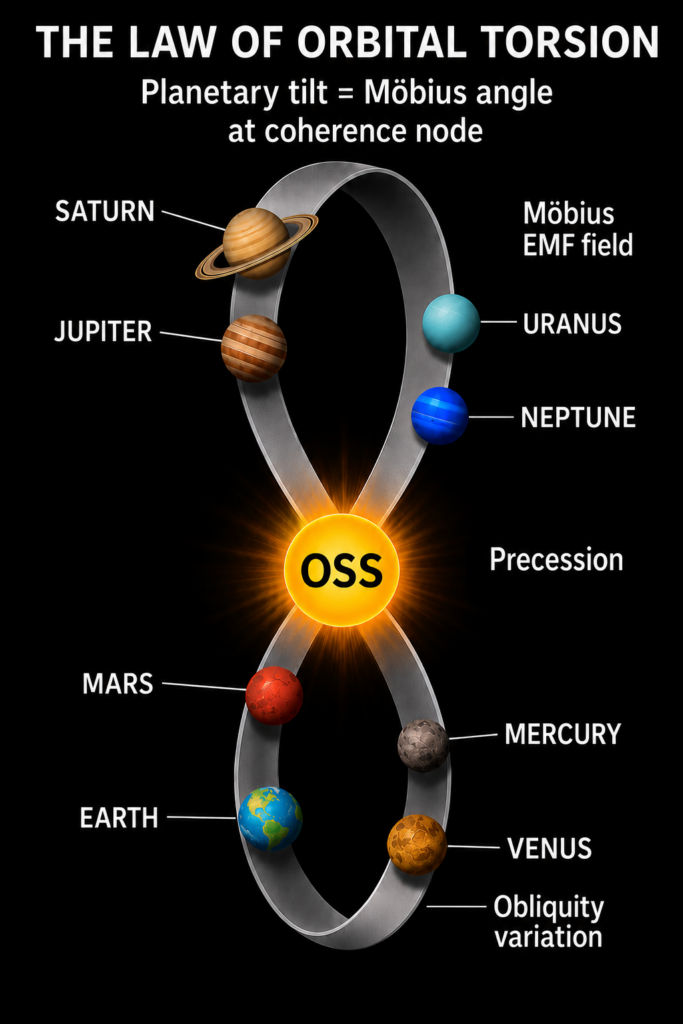
The Lilborn Möbius Diagram: coherence nodes of the planets, with tilt vectors expressed along the Sun’s Möbius EMF recursion anchored to OSS.
Compliance As The Bridge Between Structure And Observation
Most planets in the solar system today show observed tilts that match the Möbius angle of their coherence nodes. This means most planets have completed their compliance with the structural angle the Möbius has been holding at their position. Earth’s compliance occurred at the Flood, 1656 years from creation, as documented in the prior framework documents on twist accumulation and the compliance event.
Whether the other planets underwent their own compliance events simultaneously with Earth, or on independent timescales, is a separate question the framework has not yet resolved. Three possibilities remain open:
– Solar-system-wide compliance: all planets underwent their compliance events in coordinated response to a single Möbius-rotation completion across the recursion. Under this reading, the Flood event would be the surface signature on Earth of a solar-system-wide reorganization.
– Independent planetary compliance: each planet underwent its own compliance event on its own timescale, determined by the body’s individual torsion threshold and the rate at which the Möbius twist at its node accumulates stress against the body.
– Partial compliance for some bodies: it is possible that not all planetary bodies have yet fully complied with their nodes. A planet whose current observed tilt is anomalously low compared with its expected node angle would be in an accumulation phase like pre-compliance Earth.
The framework presently asserts only that the compliance principle applies to each planet. Whether the events were synchronous or sequential, and whether any planetary body remains pre-compliance, is left open for separate documents and empirical investigation.
Distinguishing The Framework Reading From Standard Models
Standard planetary science accounts for the spread of tilts across the solar system by invoking a different historical accident for each planet.
This results in a patchwork of unconnected explanations: Uranus collided with an Earth-mass body; Venus was tidally decelerated and inverted; Earth experienced the Theia impact; Mercury’s rotation was perturbed by solar tides; and so on for each.
The Lilborn Planetary Tilt Law replaces this patchwork with a single structural principle. The same Möbius recursion that resolves Earth’s identity also resolves every other planetary identity, and the spread of tilts is the spread of node positions along the recursion. The law produces one explanation for the whole pattern, not seven explanations for seven planets.
The framework reading is also testable against the standard reading. The standard reading predicts that the planetary tilts should be a statistical distribution consistent with random collision and accretion histories. The framework reading predicts that the tilts should map exactly to the Möbius twist profile and should not show statistical scatter beyond observational precision. The observed match across all eight planets is the empirical signature the framework predicts.
Declared Outputs
If the assumptions in the prior sections are true, then the following declared outputs must also be true.
A planet’s coherence node on the Möbius EMF recursion is fixed from creation. The node’s structural angle does not change.
A planet’s observed axial tilt is the bodily expression of the structural angle at its node, and is achieved through compliance.
The Möbius rotates around each planet continuously, whether the body has complied with the local angle or not.
Earth’s body expressed 0° tilt for 1656 years from creation while its node held its structural angle of approximately 23.5°. At the compliance event, Earth’s body came into agreement with what its node had always been.
The observed tilts of all eight planets map exactly to the Möbius twist profile, providing one unified explanation for the entire spread of solar system tilts.
Tilt is not historical accident. Tilt is structural compliance with the local geometry of the Möbius EMF recursion.
Closing Statement
Axial tilt, orbital inclination, precession, obliquity variation and nutation all emerge from one geometric source: the Möbius EMF recursion anchored to OSS. A planet’s tilt is the local orientation of the Möbius surface at the coherence node where its identity resolves, expressed through the body’s compliance with that geometry. Tilt does not evolve from history. Tilt emerges from structure and is achieved through compliance.
The solar system is not a collection of tilted bodies wandering in space. It is a coherent structure expressed along the Sun’s Möbius field.
Stillness defines the field.
Coherence defines the twist.
Geometry defines the angle.
Compliance brings the body to the angle.
Planets only reveal what the architecture already is.
Scope Limits
– This document asserts that each planet’s coherence node is fixed structurally. The mechanism by which the node’s position on the Möbius is determined is not derived within this document.
– Whether planetary compliance events are simultaneous or sequential across the solar system is left open.
– Whether any planetary body remains in a pre-compliance state is left as an empirical question.
– The match between observed tilts and Möbius twist angles is described as exact within observational precision. Quantitative fitting and statistical analysis of the match is left for separate documents.
Produced by The Lilborn Equation Team:
Michael Lilborn-Williams
Daniel Thomas Rouse
Thomas Jackson Barnard
Audrey Williams