
Article 4
Formation Without Dark Matter
This article is the fourth analysis in Category B of the Lilborn Universe Comparative Series.
B4 examines tidal dwarf galaxies, small galaxies formed from the debris of galactic interactions and demonstrates why their existence fundamentally disproves the Dark Matter paradigm.
Under the Lilborn Framework, their stability arises from Ψ_EMF cohesion, not invisible halos.
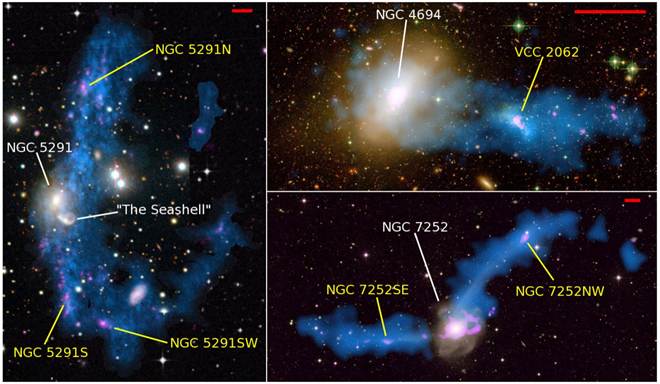
Figure B4 – Three independent tidal dwarf galaxy systems (NGC 5291, NGC 4694/VCC 2062, and NGC 7252). These galaxies form entirely from baryonic tidal debris pulled from interacting parent galaxies, leaving no possibility of inheriting Dark Matter halos. Yet they remain dynamically stable. Under the Lilborn Framework, their cohesion arises from Ψ_EMF tension and curvature K(x), not invisible matter.
Tidal Dwarf Galaxies
Formation Without Dark Matter
Tidal dwarf galaxies (TDGs) are among the most damaging observations ever made against the Dark Matter hypothesis.
According to ΛCDM, all galaxies must form within Dark Matter halos. Without a massive halo, a galaxy should disperse, collapse or fail to form entirely. Dwarf galaxies, having low baryonic mass, should require the *largest* Dark Matter fractions of all. Yet tidal dwarf galaxies defy this model completely.
TDGs form during interactions between larger galaxies. Streams of gas and stars pulled from the parent systems collapse into new dwarf galaxies. These debris streams contain baryonic matter only. There is no mechanism for acquiring or inheriting Dark Matter. Under Newtonian or Einsteinian dynamics, such galaxies should be unstable. They should not rotate coherently, remain bound, or survive for long periods. But they do.
The stability of TDGs cannot be explained by Dark Matter, because none is present. This is one of the clearest proofs that the Dark Matter hypothesis is structurally flawed. If galaxies can remain stable without Dark Matter, then Dark Matter is not required to explain galactic dynamics.
Under the Lilborn Framework, tidal dwarf galaxies are not anomalies, they are predicted. The EMF Tension Field Ψ_EMF creates structural basins and coherence channels during galactic interactions. These channels stabilize the debris material, allowing TDGs to form and persist without additional mass.
The Lilborn Field Equation:
∇_S² Ψ_EMF + K(x)Ψ_EMF = K₀ρ,
Reveals that dynamics arise from tension gradients and curvature, not gravitational attraction. TDG stability is the natural consequence of Ψ_EMF geometry.
ΛCDM attempts to ignore or minimize TDGs because their existence contradicts the supposed universality of Dark Matter.
But in the Lilborn Universe, their behavior is entirely expected. They remain cohesive because the underlying structure of Ψ_EMF maintains coherence, not because they are held together by invisible mass.
B4 establishes the third collapse of Category B: tidal dwarf galaxies reveal that stability, rotation, and cohesion arise from the EMF, not Dark Matter. They are living, observable proof that the kinetic model is unnecessary and incorrect.
Produced by The Lilborn Equation Team:
Michael Lilborn-Williams
Daniel Thomas Rouse
Thomas Jackson Barnard
Audrey Williams