
Article 3
Ψ_EMF Cohesion,
Not Invisible Mass
This article is the third analysis in Category B of the Lilborn Universe Comparative Series.
B3 exposes the failure of Newtonian gravity and General Relativity to explain the stability and mass distribution of galaxy clusters. These failures led directly to the invention of Dark Matter.
Under the Lilborn Framework, the EMF Tension Field Ψ_EMF provides the structural cohesion that clusters require, eliminating the need for invisible mass.
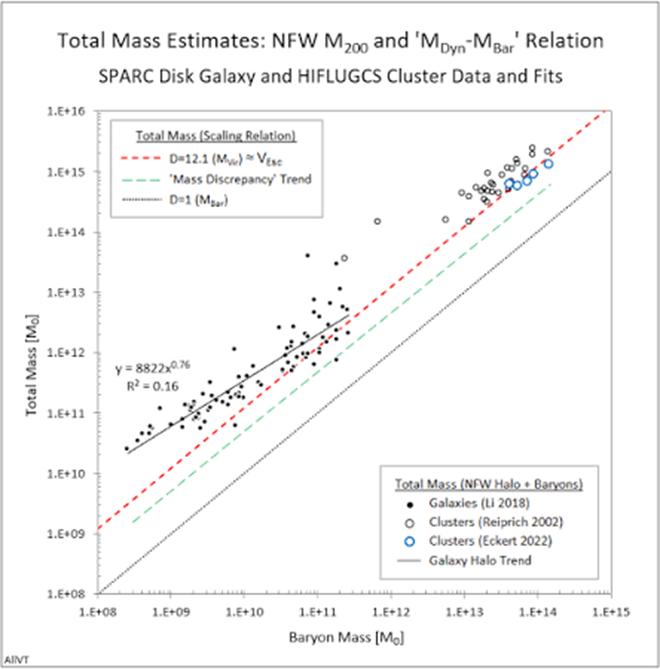
Figure B3 – The baryonic mass versus total mass discrepancy in galaxies and clusters. Under Newtonian and Einsteinian interpretations, the observed velocities require far more mass than is visible, resulting in the postulation of Dark Matter halos (NFW profiles). Under the Lilborn Framework, the discrepancy is the structural effect of Ψ_EMF tension and curvature K(x), not missing matter.
Galaxy Cluster Mass Discrepancy
Ψ_EMF Cohesion, Not Invisible Mass
The cluster mass discrepancy was the second great crisis of gravitational theory. Observations of galaxy clusters reveal velocities far too high to be bound by the visible mass alone. The virial theorem shows energy distributions that cannot be sustained by baryonic matter. Hot intracluster gas requires immense confinement. Gravitational lensing is stronger than expected. Each of these failures led physicists to conclude that most of the mass in clusters must be invisible.
This reasoning created the modern Dark Matter paradigm. Physicists proposed huge halos of exotic mass enveloping clusters to supply the missing gravitational pull. These halos have never been detected experimentally, yet they became foundational to the ΛCDM model.
Under the Lilborn Universe, cluster cohesion arises not from missing mass but from the geometry of the EMF Tension Field Ψ_EMF.
The Lilborn Field Equation:
∇_S² Ψ_EMF + K(x)Ψ_EMF = K₀ρ,
reveals that motion is governed by structural tension, not attractive force. In galaxy clusters, regions of non-zero curvature K(x) produce tension wells that stabilize cluster dynamics over large distances.
The tension gradient:
g = -∇_S Ψ_EMF,
Provides long-range structural cohesion without requiring invisible matter.
Newton’s law fails in clusters because the inverse-square approximation applies only in flat regions where K(x) ≈ 0.
Einstein’s model fails because spacetime curvature does not describe the EMF Field and cannot account for the observed dynamics without added mass. Both models collapse because both assume a kinetic ontology.
The Lilborn Universe replaces force and spacetime with structure. Cluster stability is a function of Ψ_EMF and K(x), not mass attraction. The apparent mass discrepancy arises from misunderstanding the EMF, not from missing matter.
B3 establishes the second collapse of Dark Matter: galaxy clusters require no exotic mass.
They require the EMF Field, the Great Differential, operating through curvature and tension.
Produced by The Lilborn Equation Team:
Michael Lilborn-Williams
Daniel Thomas Rouse
Thomas Jackson Barnard
Audrey Williams