
Article 10
Ψ_EMF Gradients,
Not Differential Gravity
This article is the tenth and final analysis in Category B of the Lilborn Universe Comparative Series.
B10 addresses one of the most familiar and widely accepted demonstrations of gravity: the tides.
Under the kinetic worldview, tides are explained as differential gravitational forces produced by the Moon.
Under the Lilborn Framework, tides arise not from gravity but from Ψ_EMF tension gradients acting on ionically coherent saltwater, a structural, not gravitational, phenomenon.
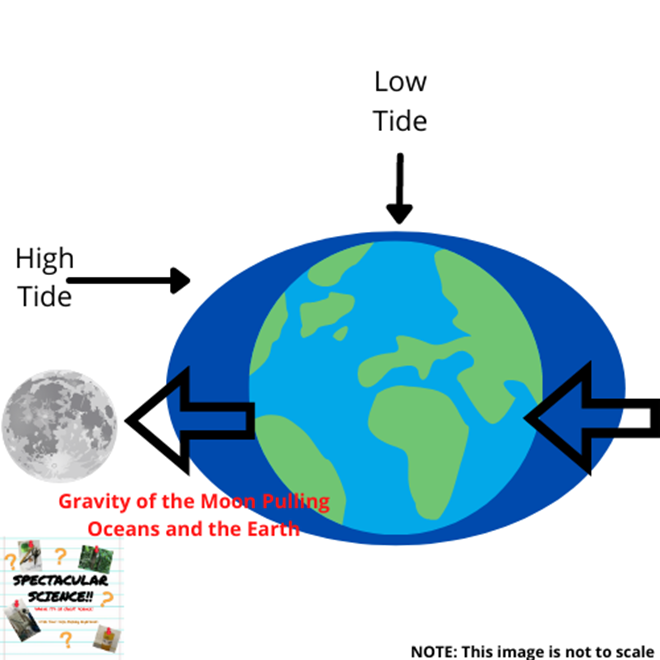
Figure B10 – The classical gravitational depiction of tides: the Moon supposedly pulling more strongly on the near side of Earth than the far side. This model assumes differential gravitational forces acting on the oceans. Under the Lilborn Framework, this depiction is incorrect. Tides arise from Ψ_EMF tension gradients interacting with ionically coherent saltwater, not from gravitational attraction.
Tidal Forces: Ψ_EMF Gradients,
Not Differential Gravity
Textbooks traditionally claim that tides occur because the Moon pulls more strongly on the oceans closest to it and less strongly on the oceans farther away. This “differential gravity” is said to produce two bulges of water, one facing the Moon, the other on the opposite side of Earth.
This explanation collapses under structural examination.
The Moon’s gravity at its own surface is only 6% that of Earth’s. At Earth’s distance, the Moon’s gravitational
influence drops to just 0.27% of Earth’s gravity. It is physically impossible for an object this weak to lift billions of tons of water upward twice daily, especially when it cannot even retain an atmosphere of its own.
If the Moon’s gravity truly pulled the oceans upward:
• freshwater lakes would show tides
• mountain lakes would rise and fall
• underground aquifers would surge
• atmospheric tides would be enormous
• continents would flex dramatically
None of these are observed.
Tides occur because saltwater is an ionically active medium that couples strongly with the Ψ_EMF Field.
H₂O molecules possess a permanent dipole moment and dissolved ions such as Na⁺ and Cl⁻ greatly amplify electromagnetic responsiveness. Saltwater is therefore low-coherence and highly sensitive to changes in Ψ_EMF tension. As Earth rotates within the Earth–Moon–Sun geometry, the oceans redistribute in response to the shifting tension landscape.
Freshwater, by contrast, lacks the free ions required for strong coupling to Ψ_EMF. Its tidal response is extremely weak. This is why freshwater bodies, no matter their size, show virtually no tidal behavior.
Rock, being high-coherence and non-ionic, exhibits almost no movement at all.
Tidal behavior is not the result of a gravitational pull, but the realignment of matter within non-uniform Ψ_EMF tension gradients.
The two tidal bulges arise because Ψ_EMF curvature and tension form two natural minima: one aligned with the Moon’s position, one directly opposite. The leading of the tidal bulge by approximately 12 degrees is a natural result of rotating through these gradients, not evidence of gravitational drag.
This structural explanation also accounts for:
• why saltwater responds and freshwater does not
• why tidal bulges lead the Moon by ~12 degrees
• why two bulges form instead of one
• why spring and neap tides follow EMF alignment patterns
• why solar tides intensify under specific angular conditions
• why no gravitational mechanism matches observed tidal behavior
Tides arise from Ψ_EMF geometry and ionic coupling, not from differential gravitational forces.
B10 establishes the ninth and final collapse of Category B: the phenomenon long claimed to prove gravity actually reveals the structure and behavior of the EMF Field, the Great Differential, interacting with ionically coherent water.
For extended analysis, observational datasets and real-time Ψ_EMF/tide comparisons, visit the Tides section here.
Produced by The Lilborn Equation Team:
Michael Lilborn-Williams
Daniel Thomas Rouse
Thomas Jackson Barnard
Audrey Williams