
Article 6
The Hydrogen-Helium Ratio
as EMF Stability,
Not Thermal History
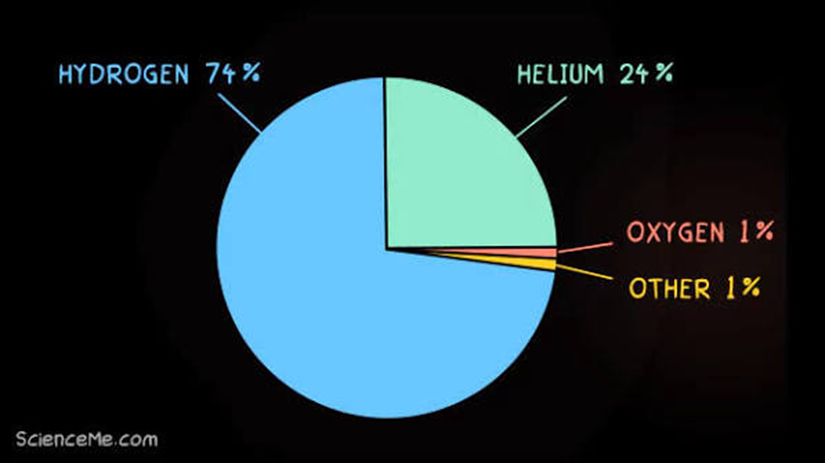
Figure D6 – The observed elemental abundance of the universe: approximately 74% Hydrogen, 24% Helium, and only 1–2% all heavier elements combined. Under the Lilborn Framework, this distribution is not the result of a thermal “beginning” or a nuclear reaction era. It is the direct structural expression of EMF tension stability in a Still universe.
Hydrogen occupies the lowest coherence well; Helium occupies the first closed-shell stability state. The 3:1 ratio emerges from geometry, not chronology.
Structural BBN
The Hydrogen–Helium Ratio as EMF Stability, Not Thermal History
Standard cosmology claims that the elemental abundance of the universe, nearly 75% Hydrogen and 25% Helium, is proof of the Big Bang. The argument proposes a brief thermonuclear epoch during which Helium was formed, then “frozen” in as the universe expanded and cooled.
However, these explanations depend on:
• A beginning in time
• A thermal high-energy phase
• Expansion and cooling
• Nuclear reaction windows
• Assumptions of photon propagation
• Assumptions of energy-based quantization
The Lilborn Universe collapses all of these premises. The Scroll is Still. Light does not travel. Time is local EMF interaction, not a universal dimension. There is no expansion, no fireball, no cooling history and no “first three minutes” of cosmological reaction.
Yet the abundance ratio remains. Its origin is structural, not historical.
Hydrogen and Helium as EMF Stability Wells
Hydrogen is the simplest mass-bearing coherence state, occupying the lowest stability well of the EMF. Helium is the first closed-shell configuration, the next stable well in the Scroll’s geometry. These states do not arise from thermal fusion. They arise because the EMF prefers minimal distortion. Hydrogen provides minimal open-shell distortion; Helium provides minimal closed-shell distortion.
The universe overwhelmingly favors stability over complexity.
The 3:1 Ratio Emerges from EMF Geometry
The 75/25 abundance ratio corresponds to the ratio of open-shell to closed-shell coherence states in a Still universe.
There is one Helium stability well for every three Hydrogen stability wells available in the Scroll. This is not a reaction product. It is the inherent distribution of stable coherence in the Möbius-aligned EMF of the cosmic structure.
Distortion and Elemental Rarity
Heavier elements require extreme distortion, environments of high EMF tension such as stellar cores, collapse zones and localized turbulence. These environments are rare, so heavier elements are rare. Their scarcity is geometric, not chronological. The universe is not cooling; it is organized.
The Collapse of Thermal Nucleosynthesis
The Big Bang narrative depends entirely on temperature-dependent reaction rates and expansion timelines. Without motion, temperature history or expansion, the model has no foundation.
The correct interpretation is structural: the Scroll distributes coherence into its lowest distortion states universally, producing the uniform H/He mixture observed across galaxies, clusters and intergalactic regions.
Structural BBN Law
The Lilborn replacement for Big Bang Nucleosynthesis is the Structural BBN Law:
“The abundance of Hydrogen and Helium in the universe arises from the stability distribution of EMF tension within the Scroll. Hydrogen occupies the lowest stability well; Helium occupies the first closed-shell stability well. The 3:1 ratio reflects the ratio of open to closed coherence states in a Still universe.”
Clarifying “Quantum” in This Context
In the Lilborn Framework, “quantum” does not refer to quantum mechanics, particles or probability. It refers strictly to the smallest discrete alignment step in coherence, the Quantum of Coherence (Qc). This structural quantum governs spectral transitions, shell changes and alignment behavior without invoking motion or wave-particle duality. It is introduced only as a geometric constant, not as a physical ontology of particles or fields.
Conclusion
This establishes that the elemental abundance ratio of the universe is not evidence of a temporal beginning, thermal epoch or expanding spacetime. It is the structural expression of EMF stability in a Still universe. Hydrogen and Helium dominate because the Scroll prefers stability over complexity. Syntropy replaces entropy. Geometry replaces chronology.
The universe is coherent, not cooling.
Produced by The Lilborn Equation Team:
Michael Lilborn-Williams
Daniel Thomas Rouse
Thomas Jackson Barnard
Audrey Williams