
Article 7
Structural Origin of
Planck’s Constant (h)
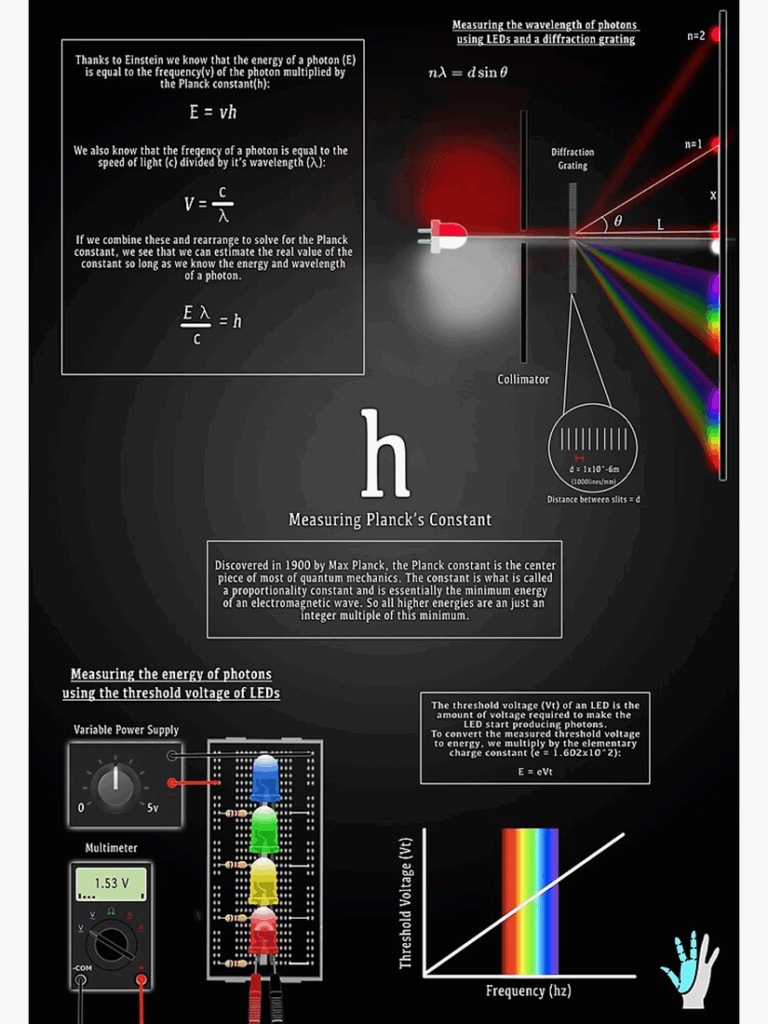
Figure D7 – This diagram represents the classical, kinetic interpretation of Planck’s constant (h): photons as particles, light as waves, diffraction, wavelength and frequency-based measurements. Under the Lilborn Framework, none of these assumptions hold. Light does not travel, photons do not exist and energy is not quantized as packets. Planck’s constant
is reinterpreted as a structural quantity derived from the Quantum of Coherence (Qc), the smallest discrete step in EMF alignment tension within the Scroll.
The Quantum of Coherence
Structural Origin of Planck’s Constant
Planck’s constant (h) sits at the heart of modern physics. It appears in every quantum formula, defines the energy of a photon, sets the scale of atomic transitions and is treated as a fundamental constant of nature. Yet its origin has never been explained. It is measured, not derived.
The Lilborn Universe does not accept arbitrary constants. Every lawful quantity must arise from structure. The final mandate of this document is to reveal the structural origin of Planck’s constant by defining the smallest discrete alignment step within Ψ_EMF, the Quantum of Coherence (Qc).
What “Quantum” Means in
the Lilborn Universe
In the Lilborn Framework, the word “quantum” has a single meaning:
The smallest discrete change in EMF alignment tension.
It is not:
• a particle
• a photon
• a packet of energy
• a probabilistic wavefunction
• a collapse event
It is purely structural, the smallest allowable increment of coherence change in the Scroll’s EMF tension.
This unit is defined as:
Qc = ΔΨ_EMF · Δℓ
where:
• ΔΨ_EMF is the minimal shift in EMF tension
• Δℓ is the minimal shift in coherence alignment length
IWhy Alignment is Quantized
Atomic shells, spectral lines and electron configurations do not arise from motion or orbiting particles. They arise from discrete allowed solutions of EMF alignment geometry. The Scroll Metric allows only certain stable configurations, and transitions between them occur in structural “steps”.
Thus, quantization is a geometric requirement, not a particle-based mechanism.
Deriving Planck’s Constant from Qc
The classical kinetic relation E = hν treats h as the proportionality constant linking frequency to energy. Under the Lilborn Framework, energy is not a substance or a packet. It is the structural cost of alignment change.
For a coherence mass m, the effective energy change per frequency cycle corresponds to:
E = (m Qc) ν
Thus:
h = m Qc
Planck’s constant is not fundamental.
It is a composite quantity arising from:
• the coherence density of a system (m)
• the smallest structural alignment increment (Qc)
This fulfills the strict mandate: the structural origin of h is derived.
Collapse of Quantum Weirdness
Once Qc replaces the classical quantum:
• wave–particle duality collapses
• uncertainty becomes a geometric boundary, not a fundamental fuzziness
• “photon emission” becomes a structural alignment change
• entanglement becomes shared EMF alignment, not nonlocal magic
• quantization becomes discrete coherence, not discrete energy packets
The universe is not quantum.
The universe is coherent and coherence changes in discrete structural steps.
The Structural Quantum (Qc) as
the Final Constant
With Qc defined and h derived, the Lilborn Framework now contains:
• the Scroll Metric
• the Field Equation
• the Distortion Law
• the Encounter Law
• the Stability Laws (H/He)
• and the coherence constant Qc
Every scale, galactic, stellar, atomic, is now unified under a single structural ontology.
Conclusion
This completes the final mandate of Category D. Planck’s constant is no longer a mysterious proportionality, but the measured expression of the Quantum of Coherence, the smallest structural change in EMF alignment tension. The kinetic universe ends here; the structural universe is complete.
Produced by The Lilborn Equation Team:
Michael Lilborn-Williams
Daniel Thomas Rouse
Thomas Jackson Barnard
Audrey Williams