
Article 1
The First Torsion
Resolution Node
Introduction
Mercury is the first planet addressed in this series not because of proximity alone, but because it occupies the shallowest torsional position within the Möbius-saturated electromagnetic field geometry of the solar body. In the Lilborn Framework, planetary orientation is not attributed to historical collisions, chaotic gravitational evolution or random accretion events. Orientation is structural. It is the local response of a planetary body embedded within a fully saturated electromagnetic field whose topology has been shaped by Fibonacci growth and resolved through Möbius torsion.
Solar Body as a Möbius-Saturated EMF
The solar system is treated here as a single electromagnetic body rather than a mechanical system of independent objects. Its coherence is governed by a fixed axis of structural stillness anchored by the Sun, outward Fibonacci growth and torsional saturation of the field into a Möbius geometry. The Möbius in this framework is not an object or surface but a saturation state of the electromagnetic field itself, required to preserve coherence once Fibonacci growth introduces irreversible asymmetry. Planets exist within this Möbius-saturated electromagnetic field as local resolution nodes.
Mercury’s Structural Position
Mercury lies extremely close to the axis of stillness where the Möbius geometry crosses its own plane. In this region, torsional strain is minimal and polarity inversion has not yet intensified. Axial compensation is therefore unnecessary. Structural stress resolves through resonance rather than tilt, making Mercury the shallowest torsion-resolution node in the solar body.
Axial Tilt as a Field Property
Mercury’s axial tilt of approximately 0.034 degrees is the smallest measured in the solar body. Within the Lilborn Framework, this value is not incidental. It corresponds directly to the local Möbius plane angle of the saturated electromagnetic field at Mercury’s position. This correspondence represents a direct structural alignment between planetary orientation and field geometry, rather than an outcome of historical chance.
Resolution Without Tilt
Mercury resolves torsional stress through spin–orbit resonance and strong electromagnetic locking to the Sun rather than through axial inclination.
This establishes an important principle for the series: axial tilt is only one possible mode of torsion resolution and appears only when other modes are insufficient. Mercury therefore represents the pre-tilt regime of the Möbius-saturated field.
Mercury as Boundary Condition
Mercury defines the lower boundary of torsional response within the solar body. Its alignment constrains the entire framework. Any deviation would collapse the model. Instead, Mercury confirms that planetary orientation is governed by electromagnetic field geometry rather than mechanical history.
Figure Reference
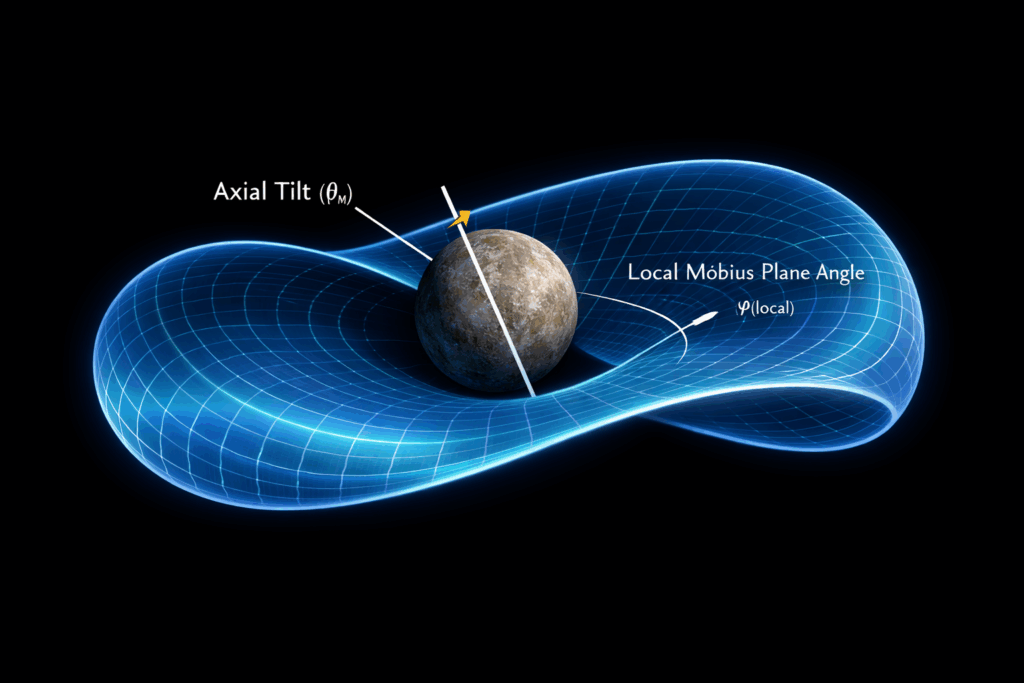
Figure 1: Illustrates Mercury positioned within the shallow torsion region of a Möbius-saturated electromagnetic field, showing the correspondence between axial tilt and local Möbius plane angle.
Closing Statement
Mercury is oriented not because something happened to it, but because it exists within a Möbius-saturated electromagnetic solar body at a position where torsion is minimal. It is the first torsion-resolution node and the necessary beginning of any structural account of planetary orientation.
Produced by The Lilborn Equation Team:
Michael Lilborn-Williams
Daniel Thomas Rouse
Thomas Jackson Barnard
Audrey Williams