
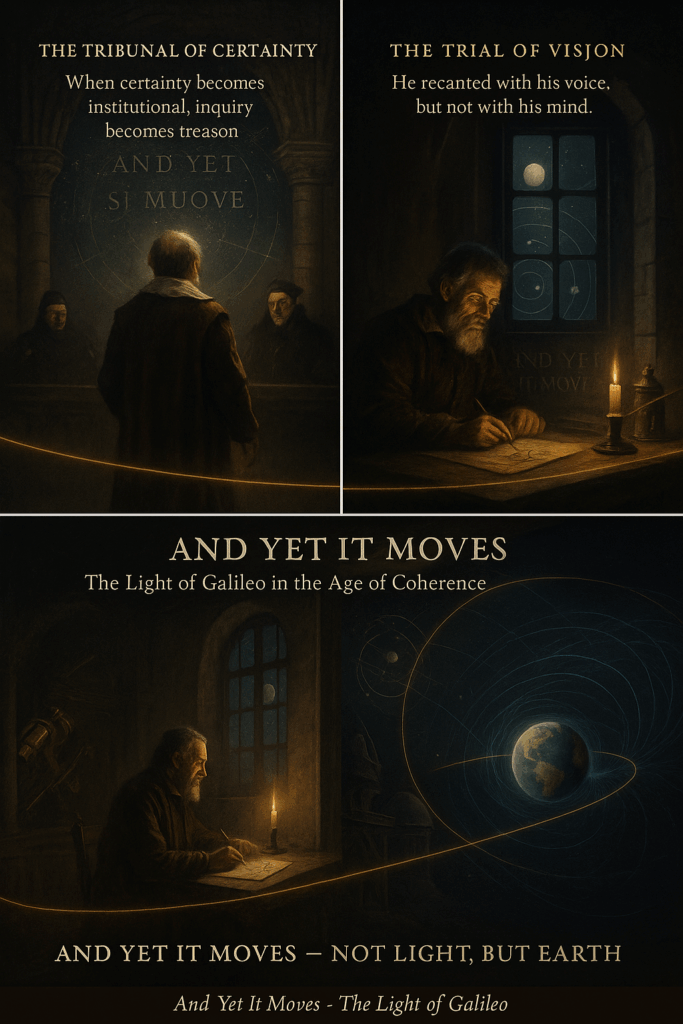
In the early 17th century, Galileo Galilei stood before the most powerful institution of his time to affirm a simple yet revolutionary truth: that the Earth was not the center of the universe. His insistence on direct observation over inherited doctrine brought him into conflict with the theological consensus enforced by the Catholic Church. He did not set out to create controversy, he sought only to reconcile the cosmos with what could be seen, measured and understood.
Today, we do not claim to be the Galileos of our time. That distinction is neither sought nor required. But we do recognize the striking parallel between Galileo’s confrontation with religious dogma and our own challenge to the unexamined axioms of modern theoretical physics. We are standing not against faith, but against philosophical inertia, the tendency of scientific culture to canonize ideas that have not produced a new law in over a century. Since the last truly declarative law in physics, the discipline has grown increasingly dependent on interpretations, simulations and untestable models, an architecture of complexity that often resists correction.
The Lilborn Equation does not seek to dismantle this structure. It offers a reconciliation, a re-grounding of scientific language, method and interpretation. It questions assumptions about motion, light, energy and coherence. It asks whether concepts like the “speed of light” are empirical discoveries or interpretive artifacts. It proposes that energy is not a conversion of mass via velocity, but a state of structural resolution that emerges in the act of containment failure or coherent encounter.
We are operating within a field that, despite its dazzling vocabulary and extraordinary computing power, has not offered the world a new fundamental law in more than a hundred years. This stagnation is not due to a lack of intelligence or effort, but to the gradual entrenchment of a paradigm that substitutes consensus for observation and treats complexity as evidence of truth.
Galileo risked everything not to create division, but to return science to the authority of what could be seen and measured. We seek the same. We invite scientists, educators, philosophers, and open minds of every discipline to examine the Lilborn Equation. Not as a rebellion, but as a restoration.
Produced by The Lilborn Equation Team:
Michael Lilborn-Williams
Daniel Thomas Rouse
Thomas Jackson Barnard
Audrey Williams