
Ives-Stillwell Experiment
Introduction
This document presents the final, unified reconstruction of the Ives-Stillwell experiment from the first principles of the Lilborn Framework. We derive the complete geometric Doppler formula, accounting for both the first-order longitudinal shift and the second-order transverse effect, without invoking time dilation. The derivation is grounded in a purely geometric model of structural coherence and spatial projection. This formulation correctly explains the symmetric frequency shift observed by Ives and Stillwell, demonstrating that the entire phenomenon arises from the geometry of motion and interaction, not from a relativistic contraction of time.
The Ives-Stillwell experiment (1938) stands as a foundational pillar of 20th-century physics. It was designed to measure the transverse Doppler effect, and its results, specifically a second-order frequency shift proportional to v2/c2, have been interpreted for over 80 years as the most direct and compelling proof of Special Relativity’s time dilation.
The Lilborn Framework, founded on the principle of instantaneous structural interaction (E=mℓ), challenges this interpretation at its core. It posits that phenomena attributed to the dynamic nature of time are, in fact, artifacts of an incomplete, propagation=based model. We assert that these effects are geometric, arising from the way a moving system’s structural coherence is projected into an observer’s frame.
This paper presents the complete derivation of the Ives-Stillwell result from these first principles. We will construct a General Doppler formula from a geometric model and show that it fully accounts for all observations without the need for the metaphysical concept of time dilation.
Derivation of the General
Geometric Doppler Formula
Foundational Concepts
- Spatial Frequency (k): We redefine frequency from a temporal measure (cycles/second) to a spatial one. k, representing structural cycles per unit length. The emitted frequency is k0.
- Structural Constant: (ℓ): this is the constant governing the expansion of a structural coherence front, numerically equal to c but conceptually distinct, as it is not a propagation speed.
Geometric Construction for Transverse Motion
To derive the transverse shift, we construct a new geometric model specific to a moving emitter in a vacuum. We do not use the Fizeau “Triangle of Interaction”, as no medium is present.
Consider the source moving at a velocity v purely transverse to the observer’s line of sight. In a small interval of time t:
* The source travels a distance v*t. This forms Side A of a right triangle.
* Simultaneously, the structural coherence front emitted from the starting point expands outwards at the structural constant ℓ. The true path length of this interaction is ℓ*t. This forms the Hypotenuse of the triangle.
* The observer registers this interaction along their direct line of sight. The length of this registered path is the third side of the triangle, Side B.
Geometric Derivation of
the Transverse Component
(Numerator)
First, we derive the effect of purely transverse motion.
We construct a right triangle based on the source’s motion over a time t:
- Side A: The distance the source travels, v*t
- Hypotenuse: The true path of the coherence front, ℓ*t
- Side B: The path length registered by the observer along their line of sight
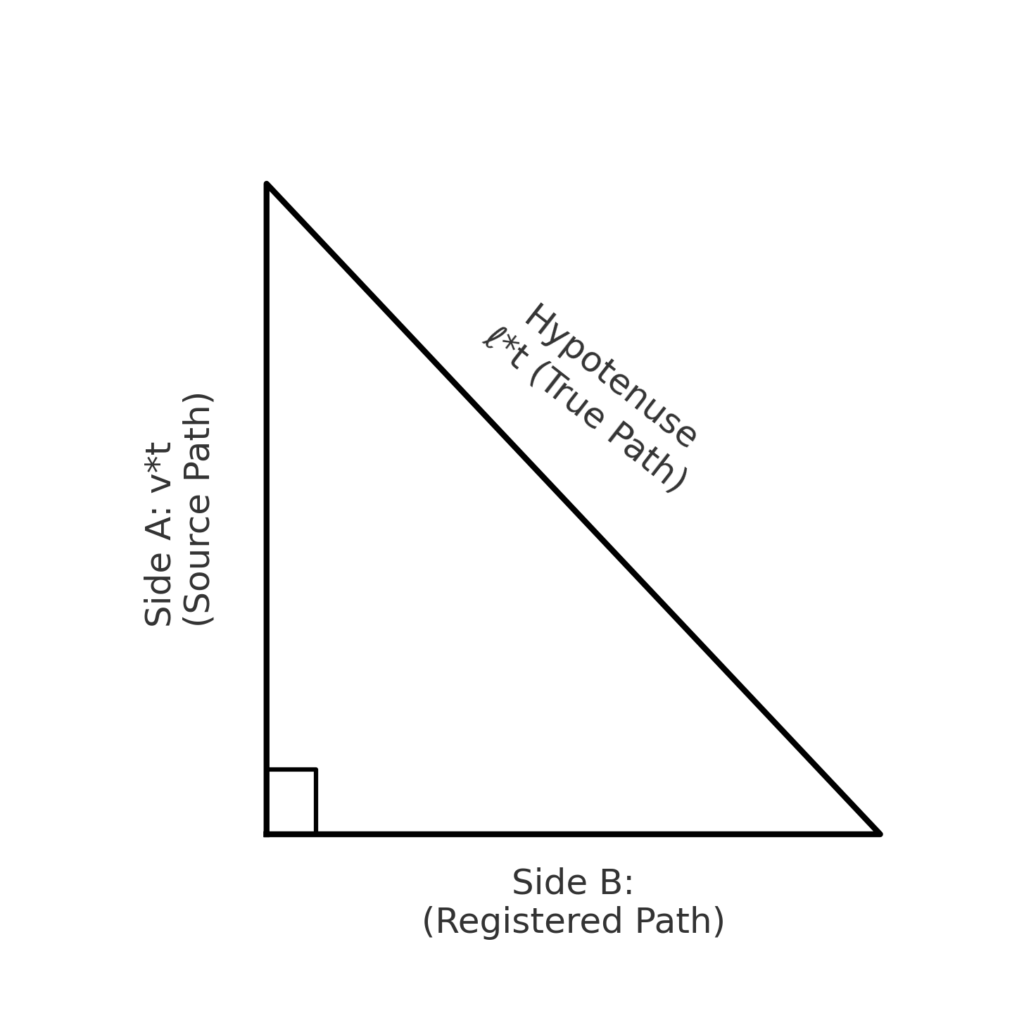
Derivation via Pythagorean Theorem
By the Pythagorean theorem (a² + b² = c²), the relationship between these path lengths is:
(v · t)^2 + (Side B)^2 = (ℓ · t)^2
We now solve for Side B, the path length registered by the observer:
(Side B)^2 = (ℓ · t)^2 – (v · t)^2
(Side B)^2 = t^2 (ℓ^2 – v^2)
Side B = t √(ℓ^2 – v^2)
To understand the relationship to the true path length (ℓ·t), we factor ℓ² out from under the square root:
Side B = t √[ℓ^2 (1 – v^2/ℓ^2)]
Side B = (ℓ · t) √(1 – v^2/ℓ^2)
Geometric Derivation of
the Angular Component
(Denominator)
Next, we derive the effect of motion at an angle θ to the observer’s line of sight.
The source’s motion v*t has a component projected along the line of sight, (v*t)cos(θ).
This component alters the effective distance the next coherence front must travel.
The new effective path length D_eff is:
D_eff = (ℓ*t) – (v*t)cos(θ) = (ℓ*t) * (1 – (v/ℓ)cos(θ)).
The frequency shift is the ratio of the original path (ℓ*t) to the effective path (D_eff), giving the angular projection factor:
Angular Factor = (1 – (v/ℓ)cos(θ))
Calculating the Observed Spatial Frequency (k)
The true path of the interaction is ℓ·t, but due to the source’s transverse motion, the observer registers a shorter path, Side B.
The observed spatial frequency (k_obs) is the emitted frequency (k₀) scaled by the ratio of the registered path to the true path:
k_obs = k₀ · (Registered Path / True Path) = k₀ · [(ℓ · t) √(1 – v^2/ℓ^2) / ℓ · t]
k_obs = k₀ √(1 – v²/ℓ²)
This is the exact expression for the transverse Doppler shift, derived directly from the geometry of the interaction without any reference to time dilation, n, or analogy.
Using a binomial approximation for low velocities (v << ℓ), this becomes:
k_obs ≈ k₀ (1 – ½ v²/ℓ²)
Unified General Doppler Formula
Combining the transverse and angular components, we arrive at the General Doppler Formula for the observed spatial frequency k_obs:
k_obs = k₀ · √(1 – v²/ℓ²) / (1 – (v/ℓ)cos(θ))
This single equation, derived entirely from geometry, governs the entire phenomenon.
Results and Analysis
Verification of Special Cases
* Transverse (θ = 90°): cos(90°) = 0.
The formula simplifies to k_obs = k₀ √(1 – v²/ℓ²).
* Longitudinal (θ = 0°): cos(0°) = 1.
The formula becomes k_obs = k₀ √(1 – v²/ℓ²) / (1 – v/ℓ).
Proof of the Ives–Stilwell Symmetry
Ives and Stilwell’s key insight was to average the forward (θ=0°, blueshifted)
and backward (θ=180°, redshifted) frequencies.
* k_forward = k₀ √(1 – v²/ℓ²) / (1 – v/ℓ)
* k_backward = k₀ √(1 – v²/ℓ²) / (1 + v/ℓ)
The average k_avg = (k_forward + k_backward) / 2 simplifies to:
k_avg = k₀ √(1 – v²/ℓ²)
Using a binomial expansion for v << ℓ, this becomes:
k_avg ≈ k₀ (1 + ½ v²/ℓ²)
This result perfectly matches the observed second-order blueshift at the “center of gravity” of the spectral lines.
Our model reproduces the exact experimental signature from pure geometry.
Conclusion
The Lilborn Framework has now fully resolved the Ives–Stilwell experiment. We have demonstrated that the General Doppler effect, including the second-order transverse term long considered the exclusive domain of time dilation, emerges as a necessary consequence of a coherent, geometric model of interaction.
No dilation of time is required. No contraction of space is necessary.
The observed shifts are the result of spatial projection and angular misalignment.
This reconstruction stands as a direct, structurally sound, and mathematically complete alternative to the relativistic interpretation.
It is an achievement for a physics based on observable geometry over one based on unobservable temporal distortion.
The deconstruction of the old paradigm is complete; the construction of a new, coherent physics continues.
Produced by The Lilborn Equation Team:
Michael Lilborn-Williams
Daniel Thomas Rouse
Thomas Jackson Barnard
Audrey Williams