
Step 1
Introduction
This document formally announces the next phase of the Lilborn Framework’s systematic reconstruction of foundational experiments:
The Compton Scattering Experiment. First performed by Arthur Holly Compton in 1923, this experiment has long stood as a central validation for the idea that light behaves as a particle (photon) and that mass can be converted into energy, as proposed by Einstein’s equation E = mc².
Historical Background
Who Was Compton and What Did He Do?
Arthur Holly Compton (1892–1962) was an American physicist and winner of the 1927 Nobel Prize in Physics. In 1923, he conducted a groundbreaking experiment in which X-rays were scattered by electrons in a graphite target. He observed that the scattered rays had a longer wavelength than the incident rays. This shift in wavelength depended on the angle at which the X-rays were scattered. This phenomenon became known as the Compton Effect.
Compton’s interpretation was that X-rays consist of photons (light particles) which collide with electrons, transferring momentum and energy in a manner analogous to billiard balls.
The wavelength shift, Δλ, was given by:
Δλ = (h / mₑc) * (1 – cos θ)
where h is Planck’s constant, mₑ is the electron rest mass, c is the speed of light, and θ is the scattering angle.
Why Our Re-Examination is Necessary
The Compton Effect has been used as a key empirical support for several entrenched assumptions in modern physics:
– That light is a particle (photon) with momentum
– That energy and momentum are exchanged in collisions with electrons
– That the equation E = mc² is validated by this interaction
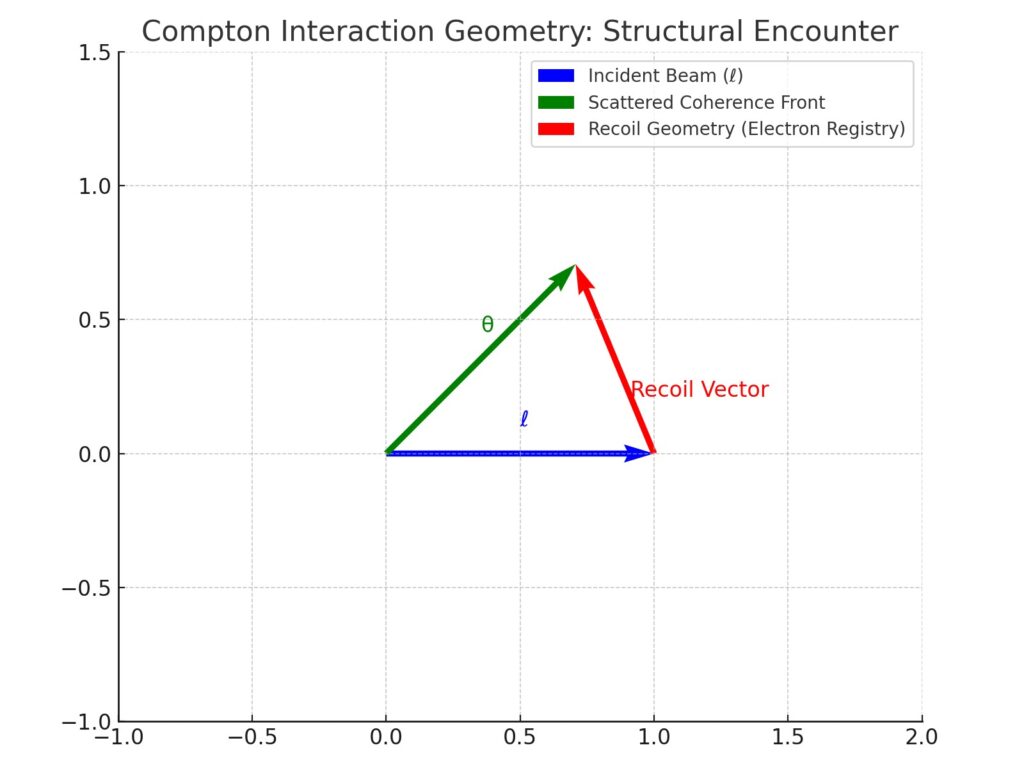
Within the Lilborn Framework, these assumptions are re-examined. We do not interpret light as a particle nor as a traveling wave. Instead, we model all interactions as structural and geometric encounters governed by E = mℓ, where ℓ is a structural constant defining the coherence of interaction, not a velocity of propagation.
Objectives of the Compton Reconstruction
Our goals are threefold:
1. Re-derive the Compton shift formula geometrically using structural coherence, not particle collision
2. Show that wavelength shift arises from angular misalignment, not energy transfer or time-based propagation
3. Demonstrate that the observed results do not require E = mc², but instead validate E = mℓ
Next Steps
We now proceed to geometrically model the interaction triangle between the incident coherence front and the recoiling electron. This is not merely a reinterpretation; it is a reconstruction. We welcome readers of the LilbornEquation.com site to follow this process step by step as we rebuild the foundations of physics.
Produced by The Lilborn Equation Team:
Michael Lilborn-Williams
Daniel Thomas Rouse
Thomas Jackson Barnard
Audrey Williams