
Article 8
Apparent Displacement, Not Refracted Rays
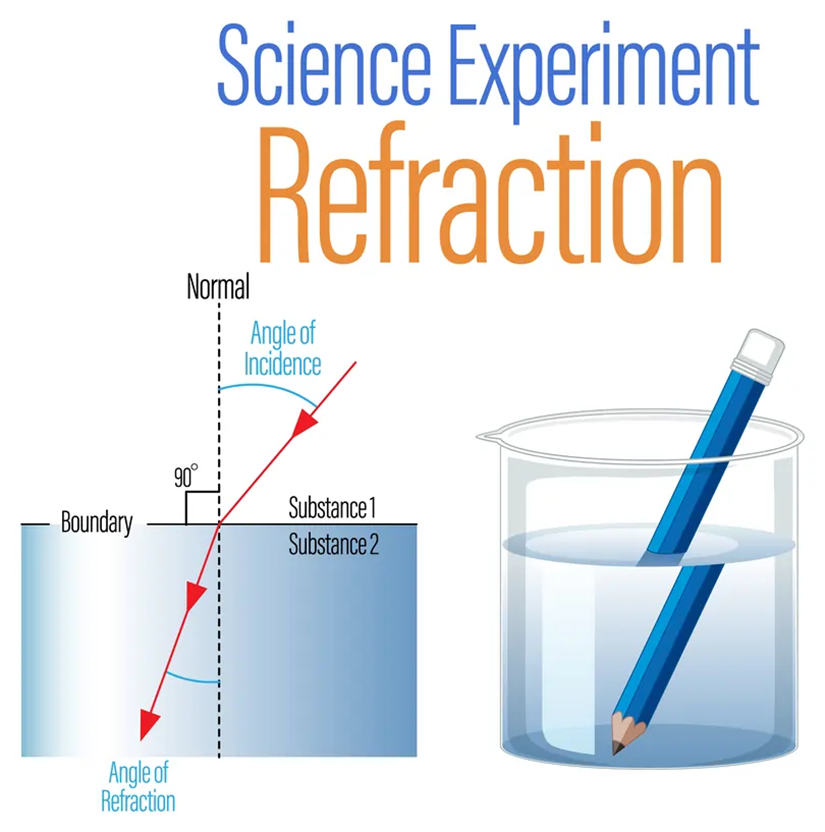
Figure C8 – The classical refraction explanation claims the pencil appears bent because light rays slow down and bend as they enter water. Under the Lilborn Framework, light does not slow, bend or travel. The pencil is not bent.
The water reshapes alignment and the Angle of Encounter (Æ), causing appearance to shift, not the light.
The Pencil-in-Water Illusion
Alignment Shift, Not Refracted Rays
The “pencil appearing bent in water” is one of the oldest and most widely used demonstrations in physics. Children are taught that the pencil looks broken because light rays travel from the pencil, cross a boundary between two media, slow down upon entering water, bend due to the ratio of speeds and then travel to the eye.
Under the Lilborn Universe, none of this occurs. Light does not travel. Light does not slow. Light does not bend.
Nothing crosses the boundary. The pencil looks bent because the geometry of encounter changes when coherence is revealed through materials of different coherence density.
The boundary does not bend the path of light. The boundary reshapes alignment.
If bending were caused by speed change, the underwater portion of the pencil would show measurable time delay, blurred edges or smeared motion when moved. None of these occur. The underwater image appears instantly and sharply because encounter, not travel, determines appearance.
What really happens is simple: as coherence passes through media of different coherence density, the local alignment vector A(x) changes. The Angle of Encounter (Æ) reorients and Ψ_EMF tension redistributes. The Scroll presents the pencil under a new encounter geometry.
Snell’s Law remains mathematically correct but physically misinterpreted. It does not describe a ratio of velocities.
It describes a ratio of alignment geometries. The kinetic worldview mistook alignment behavior for speed because it assumed photons moved through space. Under the Lilborn Universe, Snell’s Law becomes a geometric statement about how materials reshape encounter.
The pencil does not blur or distort because alignment reorients cleanly. The shift is lateral, not temporal or energetic. This cannot be explained by speed change, but it is perfectly explained by alignment geometry.
Even the famous “broken pencil” effect is not bending, it is two distinct encounter geometries revealed simultaneously: one through air, one through water. The discrepancy between them is misinterpreted as a kink in the object.
C8 establishes the eighth collapse of Category C: the pencil is not bent, light is not refracted by speed and nothing moves between the object and the observer. The Scroll reshapes appearance through coherence density, not through the slowing of light.
The pencil-in-water illusion reveals the geometry of encounter, not the motion of light.
Produced by The Lilborn Equation Team:
Michael Lilborn-Williams
Daniel Thomas Rouse
Thomas Jackson Barnard
Audrey Williams