
Article 10
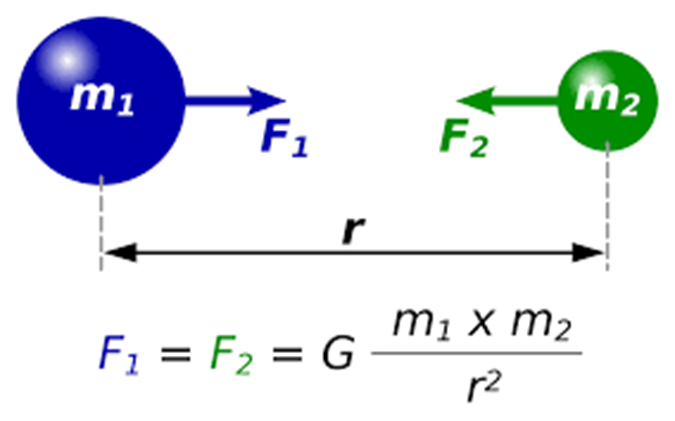
Figure D10 – The classical Newtonian depiction of “gravitational force” between two isolated masses.
This diagram contains every assumption that collapses under the Lilborn Framework: mass-based attraction, force at a distance, interaction
through empty space and the use of a universal constant G. The equation shown does not describe a universal law; it describes Earth’s local EMF distortion coefficient (G) misinterpreted as gravitational strength.
Collapse of the Gravitational Constant (G)
Modern physics rests on a single number: the gravitational constant G. It appears in Newton’s law of universal gravitation, Einstein’s field equations, orbital mechanics, cosmology, dark matter models, dark energy equations and black hole mathematics.
G is treated as:
• a universal constant
• the strength of gravity
• a property of the universe
• an invariant quantity everywhere in existence
None of this is true. G has never been measured anywhere except Earth.
Every value ever obtained for G comes from Earth’s environment, Earth’s materials, Earth’s EMF tension field, and Earth-based apparatus. In fact, G is the most inconsistent and error-prone constant in physics. Measurements vary wildly by altitude, location, method and even time of year.
This alone disproves universality.
G is not gravitational.
G is not universal.
G is not constant.
G is not a property of nature.
G is Earth’s EMF distortion coefficient, misinterpreted as gravitational strength.
The Myth of Universality
Textbooks boldly declare:
“G is the same everywhere in the universe.”
But G has never been measured outside Earth.
Not on the Moon, not in orbit, not on Mars, not on any spacecraft. Every calculation that uses G in space assumes its value, because it has never been tested.
The truth is simple:
G is not universal because gravity is not universal.
G is Earth-specific because EMF distortion is Earth-specific.
What Newton Actually Discovered
Newton did not discover a universal law. He discovered how much alignment resistance Earth’s EMF tension imposes per unit of mass. He interpreted this as “gravitational attraction”. The constant G is merely the scaling factor necessary to make his Earth-based equation fit Earth-based observations.
Had Newton lived on Jupiter or Mars, the value of G he would have found would be different.
Newton measured Earth, not the universe.
Why the Cavendish Experiment
does not Measure G
Students are taught that Cavendish “measured the gravitational constant”.
In reality, Cavendish measured:
• torsional oscillation in a wire
• EMF coupling between nearby coherence wells
• changes in alignment geometry inside an unshielded EMF environment
Cavendish did not measure a universal force.
He measured Earth’s EMF field with 18th-century instruments.
His device was influenced by:
• atmospheric charge
• nearby mineral deposits
• geomagnetic variation
• temperature and humidity
• alignment gradients inside his laboratory
Everything Cavendish detected was EMF-driven, not gravitational.
Why G Varies from One Experiment
to Another
If G were universal, it would never change.
Instead, its measured value jumps dramatically depending on:
• altitude
• latitude
• building construction
• geological density
• equipment materials
• EMF background noise
• season
• day/night cycles
This is impossible for a fundamental constant, but expected for an EMF-dependent distortion coefficient.
Why Newton’s Law Only Works on Earth
Newton’s equation:
F = G(m1m2)/r^2
only appears to work universally because G was calibrated on Earth. The moment spacecraft attempt to use Newton’s law elsewhere, Moon, Mars, Saturn, deep space, constant course corrections are needed. The model fails without continuous adjustment.
What is actually consistent is not G, but Ψ_EMF, the local tension field of each planetary body.
The Lilborn Replacement
Planet-Specific EMF Distortion Coefficients
In place of a universal G, the Lilborn Framework defines:
Ψ’(body), the EMF distortion coefficient of a given mass system.
Thus:
Ψ’ₑ = Earth’s EMF distortion coefficient
Ψ’ₘₐᵣₛ = Mars’ EMF distortion coefficient
Ψ’ⱼᵤₚ = Jupiter’s EMF distortion coefficient
Ψ’ₗᵤₙₐ = the Moon’s EMF distortion coefficient
Each planetary environment has its own tension structure.
This is why “gravity” appears stronger or weaker on different worlds.
Why Einstein Needed G
(and Why it Destroyed His Theory)
Einstein embedded G directly into his field equations:
Gμν = (8πG/c^4)Tμν
If G varies, Einstein’s equations collapse.
If spacetime is not real, they collapse.
If gravity is not curvature, they collapse.
All three conditions are true.
General Relativity depends entirely on a constant that is not constant.
The Structural Interpretation
G is not gravitational, universal, fixed, cosmic or fundamental.
G is:
• Earth’s EMF distortion scale factor
• the local calibration constant for Earth-based physics
• the ratio between coherence density and EMF alignment resistance near Earth
G is simply an artifact of Earth’s environment.
Final Structural Statement
There is no universal gravitational constant.
G is Earth’s EMF distortion coefficient, misinterpreted as a fundamental law of nature.
Removing G collapses:
• Newtonian universality
• General Relativity
• gravitational wave theory
• dark matter equations
• cosmological expansion models
• black hole physics
All “gravity” equations built on G are Earth-bound illusions.
Conclusion
D10 completes the dismantling of the gravity paradigm. G is not the strength of a universal force but the numerical expression of Earth’s local EMF tension. There is no universal gravitational constant, only the structural alignment of coherence within the Scroll.
Gravity, as a standalone concept, has been fully replaced by the geometry of EMF tension, EMF distortion and structural alignment.
Produced by The Lilborn Equation Team:
Michael Lilborn-Williams
Daniel Thomas Rouse
Thomas Jackson Barnard
Audrey Williams