
Article 7
Recursive Diminishment of Coherence Under Distortion
Aging is not decay, damage or the slow collapse of biology. It is the quiet widening of the distance between coherence and the cost of maintaining it. As long as recursive alignment exceeds distortion, life expresses itself with clarity, stability and youthfulness. Aging begins only when distortion accumulates faster than the organism can restore itself and the balance shifts from ease toward effort, from stability toward drift.
Every living structure depends on recursion: DNA recurses identity; metabolism recurses alignment; ionic cycles recurse stability; consciousness recurses awareness. But recursion never occurs in isolation. It takes place inside the shifting distortion pattern of the EMF environment surrounding Earth. With each cycle of replacement and refresh, a little more distortion remains uncorrected. Over many cycles, this asymmetry grows. The widening of this gap is what we feel as aging.
The human body replaces itself approximately every eight years, not all at once, but as a complete renewal of Carbon lattices, DNA patterns, cellular structures and ionic gradients. Though the engine of recursion remains the environment it works within becomes progressively heavier, noisier and more irregular. Seasonal EMF turbulence, atmospheric instability, ionic stress and metabolic demand slowly increase the cost of coherence, cycle after cycle. The result is not failure, but fatigue, the rising price of staying aligned.
It is worth noting that the Genesis account, one of humanity’s oldest written records, describes lifespans approaching nine hundred years. Without entering theological interpretation, this record can be treated as an observational clue suggesting that Earth once existed within a far smoother EMF environment. If such lifespans were possible, they would imply a planetary state in which distortion loads were dramatically lower, axial orientation created a more coherent solar encounter, atmospheric patterns were globally uniform and recursive cycles accumulated far less misalignment. In such an environment, the same biological engine could sustain far more cycles before coherence weakened. Whether literal or symbolic, this ancient description aligns with a structural understanding of aging as the result of environmental distortion rather than biological design.
Aging expresses itself differently across scales. At cosmic and solar levels, recursion weakens slowly; the environment is too stable for significant drift. At the planetary level, tilt, atmosphere and EMF interaction create irregularity, producing moderate distortion. At the biological level, recursion is rapid, sensitive and easily overwhelmed. Neural recursion, operating at the highest frequencies, fails first when coherence becomes expensive. Humans age faster than planets because humans recurse faster than planets.
The experience of aging is subtle at first: a slower return to clarity, a slight increase in effort, a soft drift in metabolic ease. As distortion accumulates, recursive alignment becomes harder to sustain. Consciousness itself does not weaken, only the biological system expressing it loses stability. When recursion can no longer outpace distortion, the organism approaches the natural threshold of collapse, not as a failure, but as a release.
Death is not the opposite of life. It is the moment recursion lets go. When metabolic refresh weakens, when Carbon lattices drift beyond correction, when ionic gradients lose precision, the system dissolves back into the Stillness that made life possible. Death is a return, not a disappearance. Aging is simply the approach toward that return.
In structural language, aging is recursive diminishment under distortion. Life continues only while coherence exceeds the cost of maintaining it. When distortion outweighs recursion, aging accelerates. When recursion collapses entirely, identity returns to its origin. Aging is therefore not a flaw in biology, but the natural expression of life encountering distortion over time.
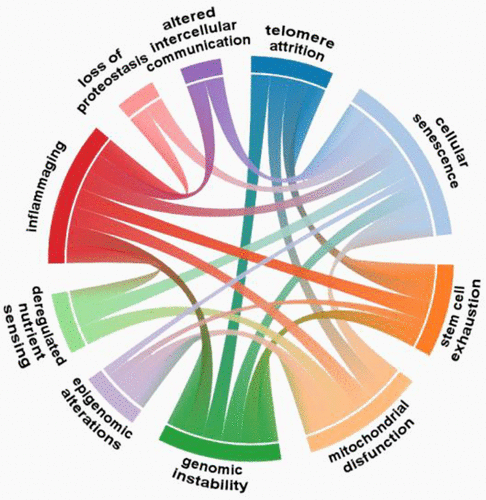
Figure E7A – Modern biology’s “hallmarks of aging”, shown here for comparison. In the Lilborn Framework, these are recognized not as causes of aging but as consequences of distortion exceeding recursive capacity.
The common scientific model identifies telomere attrition, genomic instability, mitochondrial dysfunction, stem‑cell exhaustion and other hallmarks as the mechanisms that drive aging. In the Lilborn interpretation these are not mechanisms but expressions. Each represents a subsystem whose recursive refresh has become too expensive to maintain under accumulated distortion. Biology mistakes these consequences for causes because it studies the collapse of recursion rather than the distortion that exceeds it. The hallmarks therefore serve as markers of where recursive capacity has fallen behind environmental demand.
Produced by The Lilborn Equation Team:
Michael Lilborn-Williams
Daniel Thomas Rouse
Thomas Jackson Barnard
Audrey Williams