
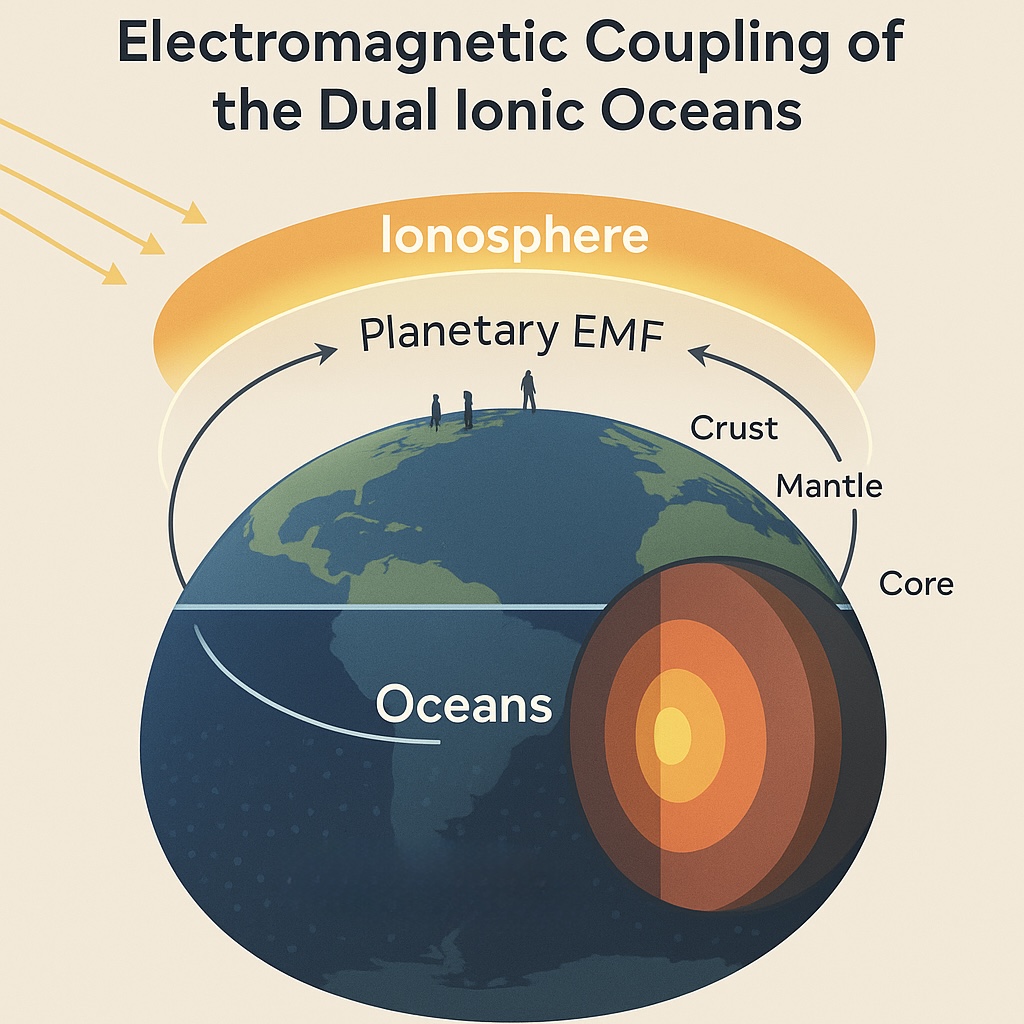
Ionic Coupling Across The Spectrum
This brief addendum summarizes how ions and molecules in Earth’s atmospheric and oceanic systems couple to different manifestations of the electromagnetic field; radio, microwave, infrared (heat) and visible light. The strength of coupling depends on charge density, mobility and the natural resonances of the ions or molecules involved.
| Medium / Species | Radio (kHz-MHz) | Microwave (GHz) | Infrared / Heat (THz) | Visible Light (100 THz) |
| Ionosphere – Free electrons | Strong reflection / refraction; plasma frequency ~5–10 MHz | Weak (passes through) | Transparent | Transparent |
| Ionosphere – O⁺, N⁺ ions | Follow E‑fields slowly; minor effect | Transparent | Thermal collisions dominate | Excited states produce auroral lines |
| Atmosphere – Water vapor | Weak | Strong absorption (rotational resonances) | Moderate (vibrational) | Scattering / transparency |
| Ocean – Ions in salt water | Good conductor for low‑freq EM | Attenuates GHz waves rapidly | Absorbs strongly | Opaque |
| Molecules / atoms (general) | Low response | Depends on dipole moment | Vibrational coupling = heat | Bound‑electron transitions → color |
Radio behaviour is dominated by free electrons in the ionosphere, giving reflection and refraction. Microwaves couple most strongly to polar molecules like water. Infrared and heat manifest through vibrational motion. Visible light corresponds to electronic transitions of atoms and molecules, appearing as discrete colours.
Each frequency band finds its preferred medium: electrons for radio, polar molecules for microwaves, lattice vibrations for heat and atomic structures for light. Together these couplings express the full range of electromagnetic coherence within Earth’s dual ionic oceans.
Produced by The Lilborn Equation Team:
Michael Lilborn-Williams
Daniel Thomas Rouse
Thomas Jackson Barnard
Audrey Williams