
When The Universe Accidentally Told
The Truth
Introduction
A Fracture That Points to Something Truer
In 1980, the inflation model of the universe was introduced as a patch to explain how the universe could appear so smooth, flat and connected, despite its scale. It claimed that space expanded faster than light, faster than the limit imposed by Einstein’s speed of light constraint.
But this quiet shift did more than plug a hole in the standard model. It broke the timeline, undid the logic of delay and accidentally gestured toward a deeper, truer framework.
That framework is captured in a different equation:
E = mℓ, the Lilborn Equation
And once the fracture is seen clearly, the entire system of delay collapses and what remains is interaction.
The Framework They Kept
E = mc²
Einstein’s equation assumes:
– Energy (E) comes from mass (m) moving at the speed of light squared (c²)
– Light is a traveler
– Time and distance define the unfolding of reality
– Redshift, expansion and universal age are all derived from how far and how fast light can move
This created a universe that was 13.8 billion years old, delayed by nothing but light’s limited velocity.
But if that delay collapses, so does the entire clock.
What Inflation Did
(Whether it Meant to or Not)
Inflation claimed:
– The universe expanded faster than light by a factor of 10²⁶
– That expansion happened in less than 10⁻³² seconds
If this is true:
– Then light never had to travel
– The universe was not built by motion, but by sudden coherence
– Light-speed delay is not necessary for the structure we now see
This directly dismantles E = mc² as a cosmological clock.
And it quietly validates what E = mℓ has said from the start:
Energy is not in motion. It is in interaction.
The Lilborn Equation
A Redefinition of Reality
E = mℓ means:
– Energy is not derived from motion, but from encounter
– Light does not move from source to destination. It exists at both ends
– Delay is not a measurement, it is a misinterpretation
Where Einstein saw velocity, the Lilborn Equation sees interaction.
Where relativity saw delay, the Lilborn Equation sees immediacy.
Inflation is not just compatible with this.
Inflation demands it.
Visualizing the Collapse
Three Critical Timelines
To understand how inflation redefines the age of the universe, we plotted three timelines:
| Inflation Factor | Age of Universe (Estimated) |
| Light Speed (no inflation) | 13.8 billion years |
| Full Inflation (10²⁶) | ~1.38 × 10⁻¹⁶ years |
| Moderate Inflation (1e6) | 6,000-13,800 years |
This range alone shows that:
– The standard model is not fixed
– Their inflation model collapses their own number
– A recalculation using their math brings us into a range between 6,000 and 13,800 years, without violating a single one of their premises
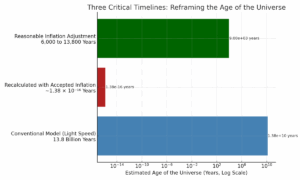
Explaining the Chart:
The horizontal bar chart compares three timelines on a logarithmic scale:
– 🟦 Blue: The standard model based on light speed = 13.8 billion years
– 🟥 Red: Age recalculated with full inflation = nanoseconds (1.38 × 10⁻¹⁶ years)
– 🟩 Green: Modest inflation = 6,000 to 13,800 years
Each bar represents a different version of cosmological time and only one of them depends on delay.
Conclusion
The Universe was Not Delayed
it Was Immediate
E = mℓ does not just challenge E = mc².
It explains why inflation makes E = mc² irrelevant.
Inflation opened a crack in the wall of delay.
The Lilborn Equation walked through it and named what inflation could not:
– Light was never in motion
– Energy is in interaction
– The universe did not take time to become present
It was present at interaction.
And now, we are too.
Produced by The Lilborn Equation Team:
Michael Lilborn-Williams
Daniel Thomas Rouse
Thomas Jackson Barnard
Audrey Williams