
…The Sun, The Earth And Their Place
In The Universe
Preamble
Is what the numbers keep showing us real
or have we simply not been willing to look?
Introduction
This series does not declare exclusivity. It examines it.
Using measurements produced by others, satellites, spacecraft, observatories and instruments humanity has placed in the solar system and beyond, ten documents follow one discipline: measurements stand, interpretations are examined and whatever the numbers show is accepted. What the numbers keep showing is a solar system that appears, at scale after scale, as something the standard model’s foundational assumption said it would not be.
The question this series asks is simple. If no preferred position exists in the universe, why do measurement after measurement reference the geometry of this particular solar system? The series does not answer that question. It documents it. Precisely, carefully, and on numbers that belong to science, not to this framework.
Document 01
Two Sources, One Field
The electromagnetic field surrounding Earth is not generated in one place. It is the product of two fields of separate origin, one rising from Earth’s core, one carried outward by the solar wind. The exclusivity of that encounter, the only fully reciprocal electromagnetic encounter confirmed in this solar system, is documented here on direct instrument measurements.
Document 02
What the Stars Actually Say
Every claim about stars as distant luminous objects rests on an assumption about light that has never been confirmed by direct observation. This document introduces ℓ, the instantaneous electromagnetic condition, replacing c and examines what the observational record actually shows when the traveling light assumption is held in the interpretation column rather than the measurement column. The exclusivity of this solar system as the only confirmed encounter site begins here.
Document 03
The Encounter Principle Meets the Observational Record
The encounter principle is tested against five categories of stellar observation: the constancy of ℓ, stellar variability, the spectroscopic record, parallax and the structural comparison between the standard model and the framework. In each category the exclusivity of confirmed measurement is separated from unconfirmed interpretation. The standard model’s difficulty with constancy disappears entirely under the encounter principle.
Document 04
The Electromagnetic Architecture of the Solar System
The solar system examined not as a collection of objects in gravitational relationship but as a field structure. Each planetary body occupies a coherence node. Earth’s exclusivity within that architecture, the only node where the encounter between the Sun’s condition and a planetary body is fully reciprocal, is documented across every measured body in the system. Distance is not the determining factor. Architecture is.
Document 05
The Primary Relationship
The synthesis document of the first arc. What the measurement record confirms, what the framework predicts and what remains genuinely open are each stated precisely. The exclusivity of the Earth-Sun encounter is confirmed on direct measurement. Its extension to galactic and cosmological scales is stated as a prediction, clearly labeled, awaiting the examination this series calls for.
Document 06
Temperature, Magnetism and the Encounter Zone
Pierre Curie’s confirmed finding, that temperature governs magnetism at a specific threshold, is placed alongside the measured behavior of Earth’s thermosphere. The equatorial thermosphere anomaly follows the magnetic equator rather than the geographic equator. No standard model explanation exists. The exclusivity of this thermal-electromagnetic governing relationship at the only confirmed reciprocal encounter in the solar system is examined as a specific testable prediction.
Document 07
The Heliopause: What the Voyager Data Actually Says
The only direct measurements of the boundary between this solar system and interstellar space. Every specific prediction the standard model made about the heliopause was wrong. The field crossed the boundary with less than two degrees of directional change. The interstellar field was twice as strong as predicted. Solar pressure waves propagated beyond it. The exclusivity of this system’s electromagnetic influence does not end at the boundary the standard model drew.
Document 08
Two Anomalies, One Question
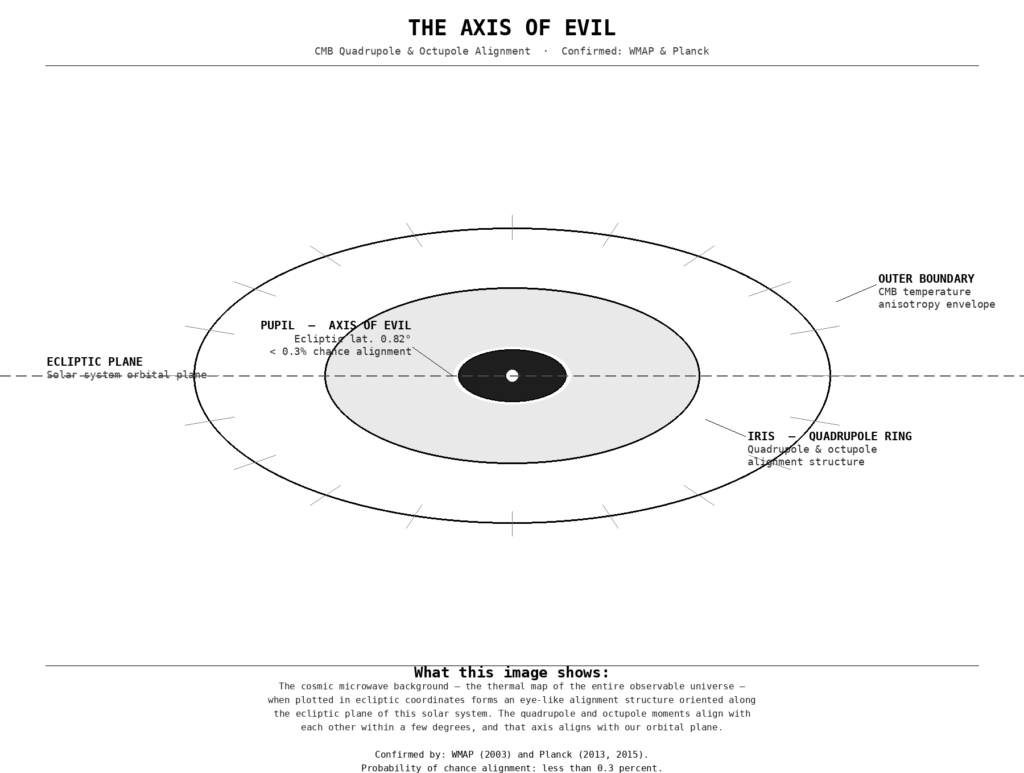
The IBEX ribbon and the CMB quadrupole alignment, the Axis of Evil, are placed in the same coordinate system for the first time. Both are anomalies the standard model did not predict and has not explained. Both reference the geometry of this solar system. No published paper has formally compared them. The exclusivity the numbers keep producing at two completely different scales is documented here on confirmed measurements.
Document 09
The Pattern the Measurements Produce
Five independent measurements at five different scales. Five failed standard model predictions. Five results that reference this solar system’s geometry. The Copernican principle, that no position is special, has not been established by the standard model’s own measurements at any scale examined. The exclusivity the data keeps producing is documented as a pattern, not a declaration. The numbers have not been run yet. This document calls for them to be run.
Document 10
What the Numbers Confirm and Where They Stop
The series closes with precision. What is confirmed is confirmed. What is not yet resolved is stated as open. The exclusivity documented across nine documents rests on confirmed measurements. At the cosmological scale the signal is real but not yet resolved at the required precision. The Copernican principle has not survived any of the five examinations this series conducted. The question the numbers keep generating has not been honestly examined. This document names what would be needed to examine it.
The standard model named the CMB alignment evil because it threatened a principle it had never proven. This series names it a question. The difference between those two responses to the same measurement is the difference between consensus and science.
Produced by The Lilborn Equation Team:
Michael Lilborn-Williams
Daniel Thomas Rouse
Thomas Jackson Barnard
Audrey Williams