
Randomized Axes
Test 1H
Introduction
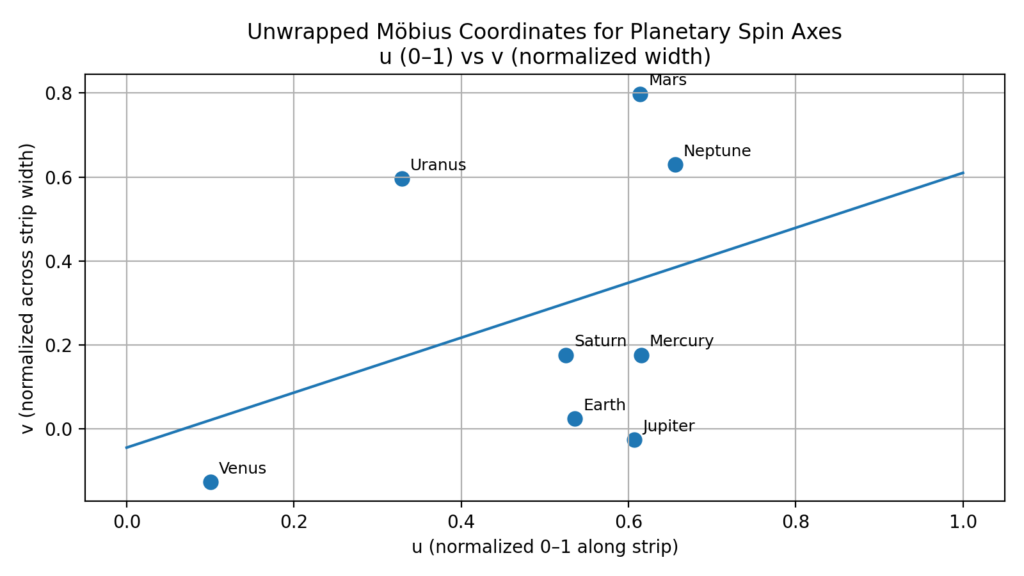
This test (Test 1H) measures how unusual the observed planetary spin-axis structure is by comparing it against randomized axis sets. This test provides a statistical baseline for the model comparisons in Series I, including planar, spherical-band and Möbius surface fits.
Observed Dataset Summary
Using the planetary spin-axis vectors (with retrograde bodies flipped to physical spin direction), the following RMS angular residuals were obtained:
Planar band RMS: 10.43°
Spherical band RMS: 9.31°
Möbius surface RMS (coarse direct fit): 1.59°
Monte Carlo Baseline
We generated N = 200 randomized datasets of 8 unit vectors uniformly distributed on the sphere and computed:
• Best-fit plane RMS for each dataset
• Best-fit spherical band RMS for each dataset
• Best-fit Möbius RMS for each dataset (coarse, using a fixed Möbius family and random rotations)
Random Baseline Summary (mean ± sd; 5th / 50th / 95th percentiles)
Plane RMS: 24.06 ± 5.79 (14.86 / 24.43 / 33.03)
Band RMS: 20.81 ± 5.42 (12.52 / 20.46 / 29.88)
Möbius RMS: 2.25 ± 0.51 (1.58 / 2.15 / 3.22)
Statistical Rarity (fraction of random datasets fitting as well or better than observed)
Plane RMS rarity: 0.015
Band RMS rarity: 0.025
Möbius RMS rarity: 0.070
Interpretation
1. The observed planar RMS (~10.4°) is unusually low relative to random expectations (mean ~24.1°), indicating that the planetary axes are not randomly distributed directions.
2. The observed spherical-band RMS (~9.3°) is also unusually low relative to random expectations, showing that the axes form a structured band rather than a random scatter.
3. The observed Möbius RMS (~1.59°) is near the 5th percentile of the random Möbius-fit distribution under this coarse procedure. Even with conservative fitting, the planetary set is more compatible with a twisted surface than would typically occur by chance.
This does not establish causation. It does establish that the observed planetary orientation structure is statistically non-random and that the twisted-surface description performs strongly within a rigorous baseline comparison.
Notes on Rigor
The Möbius fit used here is a conservative, coarse direct-fit approach (finite Möbius family, finite random rotations). A full optimizer (continuous rotation and strip parameters) would refine the RMS values further. This test therefore provides an honest baseline without overfitting the model.
Conclusion
This test supports the Series I finding that the planetary spin-axis structure is not a random configuration and that a twisted topological surface provides a strong organizing description relative to baseline models.
Produced by The Lilborn Equation Team:
Michael Lilborn-Williams
Daniel Thomas Rouse
Thomas Jackson Barnard
Audrey Williams