
…And Robustness Checks
Introduction
This addendum attaches the visual and robustness diagnostics requested after the Full Numeric Plus Significance critique. It also records an essential methodological clarification about the data product used.
Critical Clarification
What the IGS CLK Drift Represents
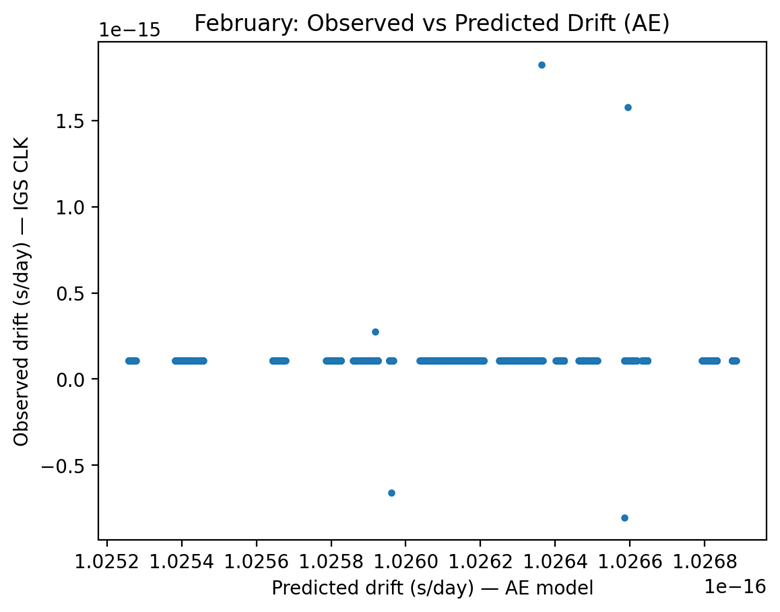
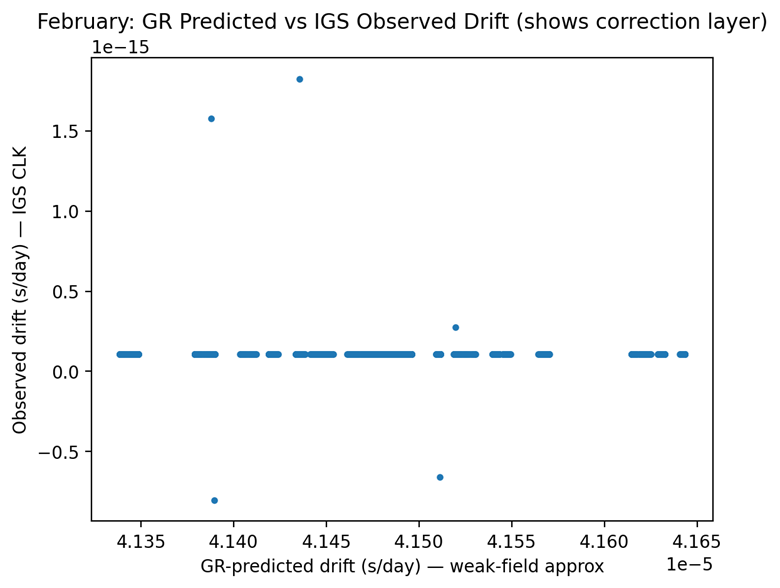
The IGS combined RINEX CLK files used in this study are not raw onboard clock rates in the sense of an unmodeled 38 microseconds per day proper-time drift. They are estimated clock corrections relative to a reference timescale within a processing framework that already includes standard models. Therefore, the observable drift surface extracted from IGS CLK is a residual correction surface, typically near zero. This is not a flaw. It is the correct interpretation of what this product contains.
Consequently, the Ӕ-model fit presented in I-B demonstrates that the residual correction surface can be carried and predicted out-of-sample under the declared sigma(r) and eta(Omega) parameterization. It does not, by itself, constitute a direct measurement of the uncorrected 38 microseconds per day figure often cited in public explanations. A direct confrontation with that headline number requires raw onboard frequency offsets or a dataset that preserves the unmodeled proper-time rate difference.
Fitted Parameters Used
alpha (January fit) = -8.505793e-10
beta (January fit) = 1.748911e-10
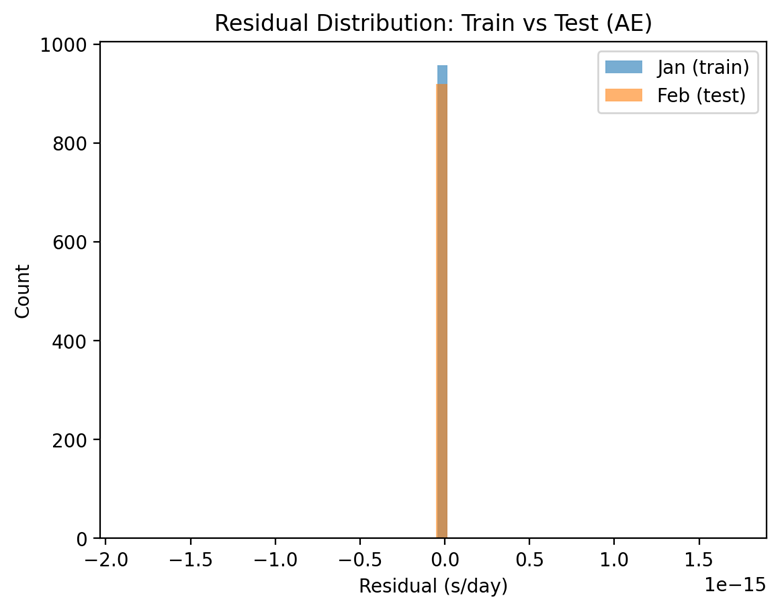
February test residual RMS = 8.441536e-17 s/day (0.000000 μs/day)
February max abs residual = 1.721222e-15 s/day (0.000000 μs/day)
Visual Diagnostics
February observed vs predicted drift under the Ӕ model.
Residual distribution comparison between training (January) and test (February).
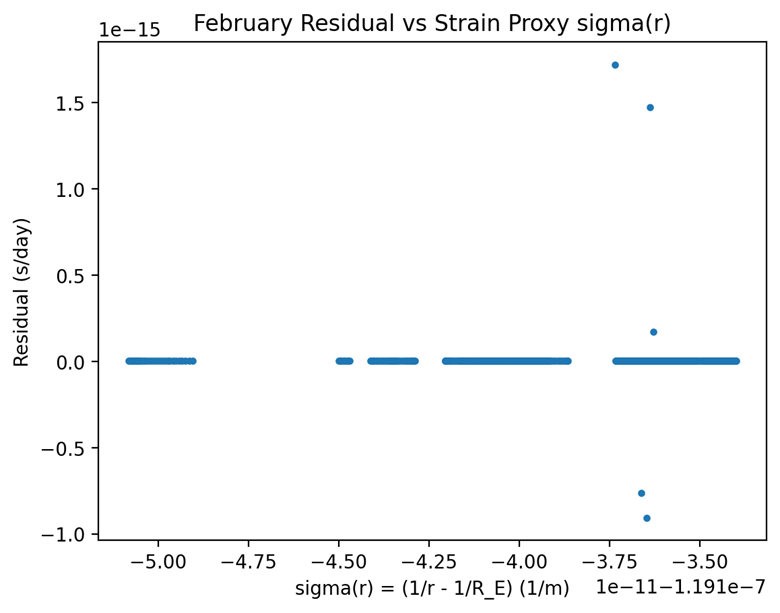
February residuals versus the strain proxy sigma(r).
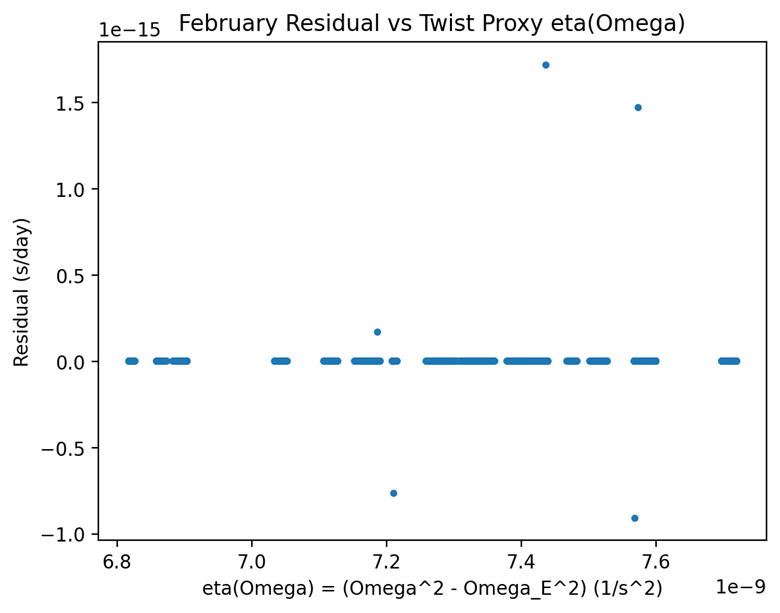
February residuals versus the twist proxy eta(Omega).
Comparison Plot Illustrating
the Correction Layer
The plot below compares a simple weak-field GR drift estimate (computed from orbit radius and speed) to the drift extracted from the IGS CLK residual surface. The large offset is expected, because the IGS clock product is a correction product, not an uncorrected proper-time drift stream.
Robustness Checks Within the Same Dataset
Within the same sixty-day window, robustness can be further assessed by alternate locked splits (for example early-January fit and late-January test), or leave-one-satellite-out validation. These checks remain within the same regime contrast and therefore test overfitting resistance rather than regime generality.
Conclusion
This addendum strengthens transparency. It shows the fit visually, and it states plainly what the IGS CLK product does and does not represent. The next escalation step, if desired, is acquisition of a dataset that preserves the uncorrected clock-rate difference associated with the public 38 microseconds per day claim.
Produced by The Lilborn Equation Team:
Michael Lilborn-Williams
Daniel Thomas Rouse
Thomas Jackson Barnard
Audrey Williams