
Galileo, Cassini And The Stand For What Is Seen
July 22nd, 2025
Galileo was the first man to aim a telescope into the sky and have the courage to say what he saw. In 1610, using one of the earliest telescopic lenses, he identified four celestial bodies orbiting Jupiter. These moons, Io, Europa, Ganymede and Callisto, are now known as the Galilean moons. Their very existence challenged the prevailing geocentric doctrine, which held that all heavenly bodies revolved around the Earth.
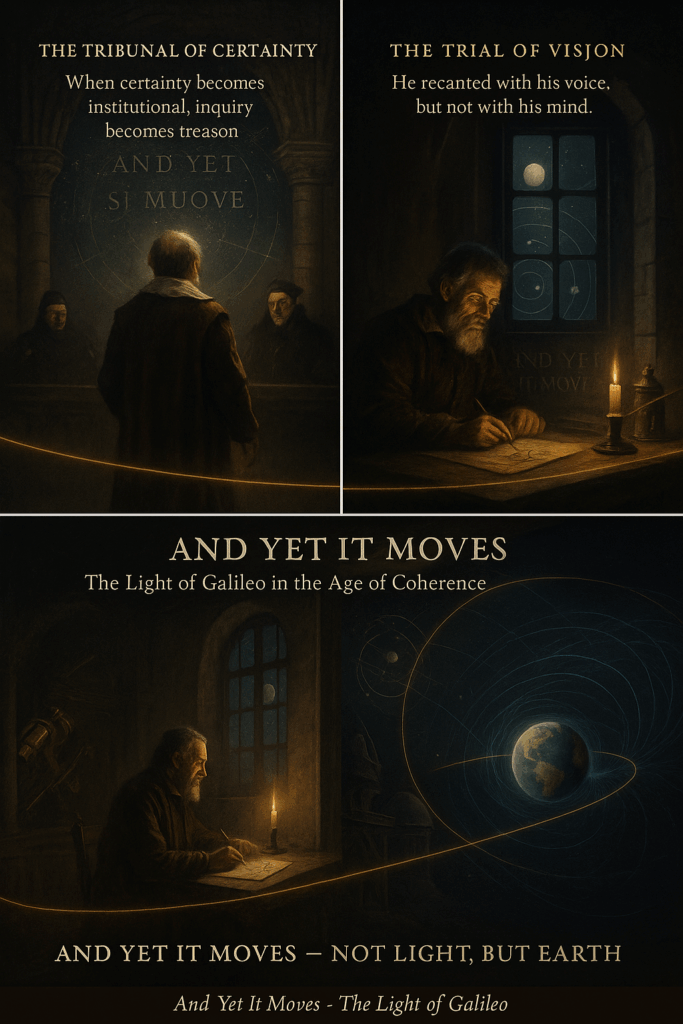
Galileo did not oppose the Church. He remained a devout Catholic, believing that truth in nature revealed the mind of God. His writings reflected loyalty to Catholic doctrine even as his observations contradicted the Church’s interpretation of Scripture. But it was Pope Urban VIII, once his admirer, who turned against him when Galileo insisted the Earth moved around the Sun. Under threat of torture, Galileo was forced to recant in 1633. He was sentenced to house arrest for the rest of his life.
Yet legend has it that after he recanted, he muttered:
“E pur si muove.” And yet it moves.
From this courageous foundation emerged a new age of astronomical discovery.
Nearly six decades later, Giovanni Domenico Cassini, director of the Paris Observatory, hired a young Danish assistant: Ole Rømer.
By 1676, Rømer had tracked the eclipses of Io and announced a radical conclusion: light has a speed and it takes time to travel. He estimated that light took 22 minutes to cross the diameter of Earth’s orbit.
At first, Cassini supported the idea. In 1672, he himself had noted a similar delay. But his integrity as a scientist would not allow him to accept a theory that only worked part of the time. Cassini later withdrew his support, not because he opposed the concept of a finite speed of light, but because Io was the only one of Jupiter’s four main moons to show the effect Rømer described.
Europa often passed through Jupiter’s penumbra, making its eclipses dim and erratic. Ganymede entered the umbra at varying angles, producing soft transitions. Callisto, the farthest out, barely intersected the shadow at all. None of them showed the same clean, timed eclipse pattern that Io did. Cassini was forced to apply different corrections for each moon. If the delay were due to light speed, every moon should have shown the same result. They did not. And so he withheld his endorsement.
This was not rivalry. It was discipline. Scientific law must apply consistently. If only one moon agrees with the theory, and the others contradict it, the theory is not yet proven. Cassini did not object to imagination, he objected to shortcutting the evidence. He stood with the data.
This through-line of integrity runs from Galileo to Cassini, a willingness to observe what is there, even when it is costly. Galileo was imprisoned for seeing too much. Cassini was nearly forgotten for refusing to see too little.
Today, as theoretical physics spins stories of invisible particles, multiverses, and space-bending light, we return to the foundation these men laid: that observation matters. That the heavens do not require permission to be seen, only honesty to be described.
Cassini was not a doubter. He was a defender. Galileo was not a rebel. He was a revealer. Together, they began a tradition of standing for what is seen.
And that tradition now lives on.
Let us follow the light they encountered, not chasing it, but acknowledging it.
Produced by The Lilborn Equation Team:
Michael Lilborn-Williams
Daniel Thomas Rouse
Thomas Jackson Barnard
Audrey Williams