
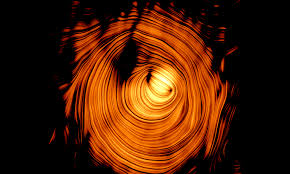
Image courtesy of European Research Council
The image now making the rounds in both scientific circles and the popular press, PKS 1424+240, nicknamed the “Eye of Sauron”, is breathtaking. The swirling spiral and bright central jet are presented as direct visual evidence of a supermassive black hole launching matter at near-light speeds from its accretion disk. It’s the kind of narrative that captures imaginations. But here in our new series, “What’s Wrong With This Picture?”, we take a closer look at what we’ve been told.
The standard interpretation demands two things that have never been observed directly: an event horizon, and the singularity at its heart. These are theoretical consequences of spacetime curvature, not direct observations. The explanation hinges on the belief that the only possible engine for such jets is a black hole’s gravitational well, twisting space and time itself.
From the perspective of the Law of Universal Coherence (E = mℓ), this is not the only path to understanding what we see. Our framework does not require spacetime curvature or singularities. Instead, it interprets such structures as the visible geometry of a massive, coherent, and saturated Ӕ–EMF field. The “jet” is not matter escaping an inescapable well; it is the visual trace of the field’s angular encounter geometry. The spiral pattern marks the alignment of coherent field lines, real, measurable and consistent with what we have already demonstrated in other high-precision tests.
In other words: the image is real, but the story attached to it is not the only scientifically defensible one. Under the Law of Universal Coherence, PKS 1424+240 becomes not a terrifying gravity trap, but a spectacular example of the universe’s geometric field in action, massive, stable and coherent.
This is why our work matters: if we can reproduce the numbers behind black hole claims without the assumptions of curved spacetime, then our physical interpretation must be given a fair hearing. The images will remain beautiful, but the truth behind them may be far simpler, and far more coherent.
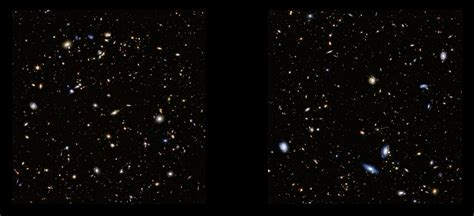
Image courtesy of Hubble Telescope
The James Webb Space Telescope’s stunning deep-field image of the Hubble Ultra Deep Field has been hailed as “the deepest view of the universe ever”. In public storytelling, we are told we are looking billions of years into the past, light from the “cosmic dawn”, traveling across incomprehensible distances to reach us now.
But there’s something wrong with this picture.
First, the image is not a direct view of distant galaxies. It is a profoundly processed dataset, false-color mapped from near- and mid-infrared wavelengths to the visible spectrum, each hue representing assigned energy levels and wavelengths. This process is a marvel of engineering, but it is also an interpretation, not a literal snapshot. The dazzling “colors” we see are not objects themselves, but a model of their energy output. This crucial fact often disappears in the excitement of public release.
Second, the standard interpretation rests entirely on the assumption that light has traveled for billions of years from these sources to our telescopes. This is the foundation of modern cosmology’s age estimates. But the Law of Universal Coherence (E = mℓ) offers a different, predictive explanation. In this framework, what we are observing is not ancient light finally reaching us, it is an immediate, local consequence of the geometric state of a coherent, saturated electromagnetic field (Ӕ–EMF) extending across the cosmos.
The galaxies in this image are not “frozen moments” from the distant past. They are present structures, their geometry manifesting instantly through the Ӕ–EMF field. The so‑called “lookback time” is not a voyage of photons through space; it is the time it takes us to recognize the field geometry for what it is.
Why does this matter? Because it means the universe’s appearance does not require billions of years of light travel. It requires only the immediate coherence of the field itself, a framework that resolves the “lookback time problem” without stretching the age of the universe to fit the model.
The James Webb Space Telescope has given us more than just a deep-field image. It has given us a window into the universe’s coherent field structure, a direct invitation to rethink one of the most deeply held assumptions in modern science.
Let us look again, not just at the image, but at the assumptions that shape our interpretation. Sometimes, what’s wrong with the picture is not the picture itself, it’s the story we’ve been told about it.
Produced by The Lilborn Equation Team:
Michael Lilborn-Williams
Daniel Thomas Rouse
Thomas Jackson Barnard
Audrey Williams