
Article 2
Polarity Inversion As
Torsion Resolution
Introduction
Venus follows Mercury in this series not because of distance alone, but because it represents the next unavoidable torsion-resolution mode within the Möbius-saturated electromagnetic field geometry of the solar body. Where Mercury demonstrates torsion resolution without axial tilt through resonance and electromagnetic locking, Venus demonstrates torsion resolution without axial tilt through global polarity inversion.
Venus is therefore not a failed Earth, nor an anomalous planet. It is the necessary intermediate structural expression between pre-tilt resonance and balanced axial inclination. Without Venus, Earth’s orientation would appear arbitrary. With Venus placed correctly, Earth becomes inevitable.
Solar Body and the Möbius-Saturated EMF
As established in document 1, the solar system is treated here as a single electromagnetic body whose coherence is governed by a fixed axis of structural stillness anchored by the Sun. Outward Fibonacci growth introduces irreversible asymmetry in radial spacing and encounter intensity. To preserve global coherence under that growth, the electromagnetic field saturates torsionally into a Möbius geometry.
The Möbius in this framework is not an object, not a surface and not a path. It is a saturation state of the electromagnetic field itself. Planets exist within this Möbius-saturated electromagnetic field as localized resolution nodes responding to global torsional geometry.
Venus’s Structural Position
Venus occupies a radial position where the Möbius-saturated electromagnetic field has already passed through polarity inversion relative to the fixed axis of stillness. At this position, torsional strain is no longer shallow, as it is at Mercury, but axial tilt is not yet the most stable solution.
This places Venus in a unique structural regime. The field geometry at Venus’s radius demands resolution of torsion, but that resolution cannot be achieved efficiently through axial displacement without introducing instability. The system therefore resolves torsion through a different mechanism.
Polarity Inversion as a Resolution Mode
Venus resolves torsional strain through global polarity inversion rather than axial tilt. This inversion manifests as retrograde rotation, in which the planet’s rotational sense is reversed relative to the dominant orientation of the solar body.
This inversion is not the result of collision, tumbling or chaotic disturbance. It is a coherent, global re-registration of the planet’s orientation relative to the local electromagnetic field geometry. Venus does not tilt into balance. It flips into coherence.
Axial Orientation Without Axial Tilt
Despite its inverted rotation, Venus maintains an extremely small axial tilt relative to its orbital plane. This combination, retrograde rotation with minimal axial inclination, is not contradictory within the Lilborn Framework. It is precisely what is expected when torsion is resolved by polarity inversion rather than axial displacement.
Venus therefore confirms that axial tilt is not a universal requirement for torsion resolution. It is one of several possible structural responses available to a planetary body embedded within a Möbius-saturated electromagnetic field.
Correspondence With the
Local Möbius Geometry
Venus’s inversion occurs in direct correspondence with the local orientation of the Möbius-saturated field at its radial position. The planet’s global polarity aligns with the inverted field geometry rather than resisting it. This correspondence explains the long-term stability of Venus’s retrograde rotation.
Venus is not upside down relative to space. It is right-side-up relative to its local field geometry.
Venus as the Necessary Bridge
Venus serves as the indispensable bridge between Mercury and Earth. Mercury shows that torsion can be resolved without tilt through resonance. Venus shows that torsion can be resolved without tilt through inversion. Once both of these non-tilt resolution modes are established, the emergence of axial tilt as a stable solution at Earth’s radius becomes unavoidable.
Venus removes freedom from the system. After Venus, the remaining planets must resolve torsion through axial inclination, instability or extreme inversion.
Figure Reference
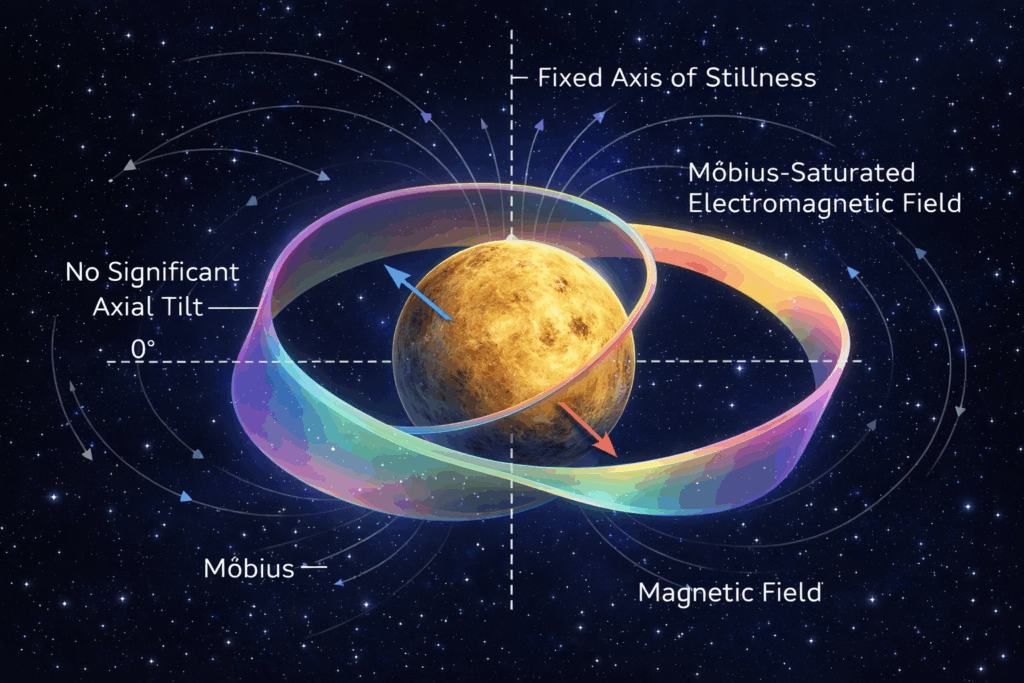
Figure 1: Illustrates Venus embedded within a Möbius-saturated electromagnetic field geometry, showing polarity inversion relative to the fixed axis of stillness and the absence of significant axial tilt.
Closing Statement
Venus is not an anomaly to be explained away. It is a structural necessity within a Möbius-saturated electromagnetic solar body. Its retrograde rotation represents polarity inversion as a torsion-resolution mode, confirming that planetary orientation is governed by field geometry rather than historical accidents. With Mercury and Venus correctly placed, the remainder of the solar body becomes structurally constrained. What follows is no longer speculative, but predictable.
Produced by The Lilborn Equation Team:
Michael Lilborn-Williams
Daniel Thomas Rouse
Thomas Jackson Barnard
Audrey Williams