
Article 4
The Unstable Echo
Beyond Equilibrium
Introduction
Why Mars Comes After Earth
Mars follows Earth in this series not because of distance alone, but because it is the first planetary body that lies beyond the equilibrium node of the Möbius-saturated electromagnetic solar body.
Mercury demonstrated torsion resolution without axial tilt through resonance.
Venus demonstrated torsion resolution without axial tilt through polarity inversion.
Earth demonstrated torsion resolution through stable axial inclination.
Mars answers the next unavoidable question: what happens when axial tilt remains the correct resolution mode, but coherence lock is no longer available?
Mars is not a mystery. Mars is a structural consequence.
Mars’s Structural Position
in the Saturated Field
By the time outward Fibonacci growth carries the solar electromagnetic field beyond Earth’s radial position, the Möbius geometry is already complete and saturated. The topology is no longer changing. What changes is the difficulty of maintaining coherence within that fixed geometry.
Mars occupies a position just beyond the equilibrium radius. At this location, torsional strain still demands axial resolution, polarity inversion would overcorrect, resonance alone is insufficient and axial tilt remains necessary. Unlike Earth, however, Mars does not sit at a coherence minimum. Mars overshoots the balance point.
Axial Tilt Without Lock
Mars’s current axial tilt of approximately 25 degrees closely mirrors Earth’s 23.5-degree tilt. This similarity confirms that Mars is attempting to resolve torsion using the same axial inclination mode. However, Mars lacks the conditions required for long-term coherence lock.
As a result, its axial tilt is not bounded. Its obliquity varies chaotically over geological timescales, and its orientation is highly sensitive to perturbations. In conventional language this is called chaos. In the Lilborn Framework, it is post-equilibrium instability.
Mars demonstrates a critical truth: axial tilt without saturation lock becomes dynamically unstable.
Obliquity Chaos as Structural Signature
Mars’s obliquity is known to wander between near-zero and greater than sixty degrees over millions of years. This behavior is often attributed to unpredictable gravitational interactions. Here it is understood as diagnostic.
Mars is resolving torsion correctly, but without sufficient stabilizing capacity. The result is a system that continuously searches for equilibrium but never finds a resting point. Mars is the echo of Earth’s solution without Earth’s coherence margin.
Atmospheric Loss as Consequence, Not Cause
Mars is frequently explained through atmospheric loss, climate collapse or impact history. In this framework, those phenomena are downstream effects. Axial instability leads to extreme seasonal variability, episodic concentration of encounter intensity, inability to sustain long-term surface coherence and gradual atmospheric erosion.
Mars did not lose its atmosphere and then become unstable. Mars was unstable because it lies beyond the equilibrium node.
The Absence of a Stabilizing Sub-Node
Earth’s stability is enhanced by the presence of a large, coherent sub-node that helps maintain bounded obliquity. Mars lacks such a stabilizing structure. This absence does not create instability by itself, but fails to correct instability already present due to radial position.
Mars therefore reveals an important principle: stabilizers can preserve equilibrium, but they cannot create it where geometry does not permit it.
Mars as Proof That Earth is Not Arbitrary
Mars is essential to the series because it removes the illusion of chance. If Earth were merely lucky, Mars could have been similar. If axial tilt were freely tunable, Mars could have stabilized. Mars does neither.
Mars proves that the equilibrium node is narrow, real, and unforgiving.
Imagery Reference
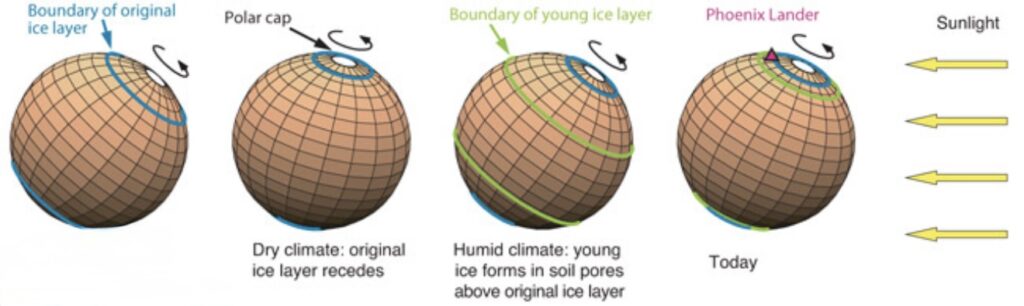
Figure 1: Mars obliquity variation over geological time illustrating instability beyond equilibrium.
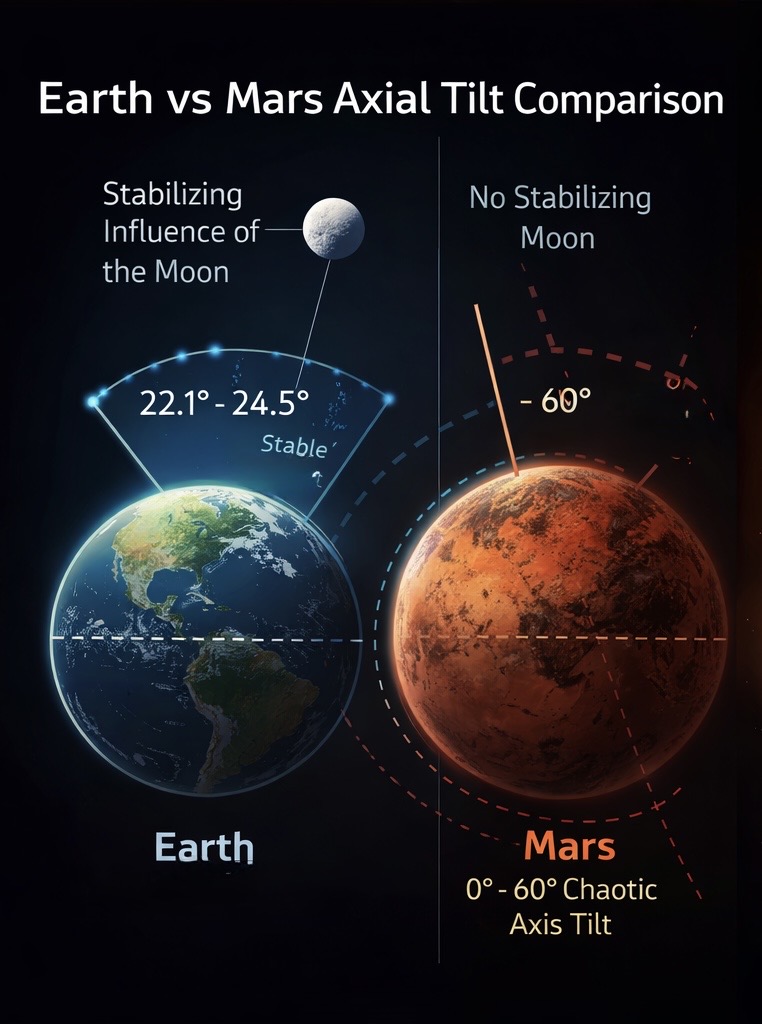
Figure 2: Comparative axial tilt showing Earth’s stability versus Mars’s chaotic variation.
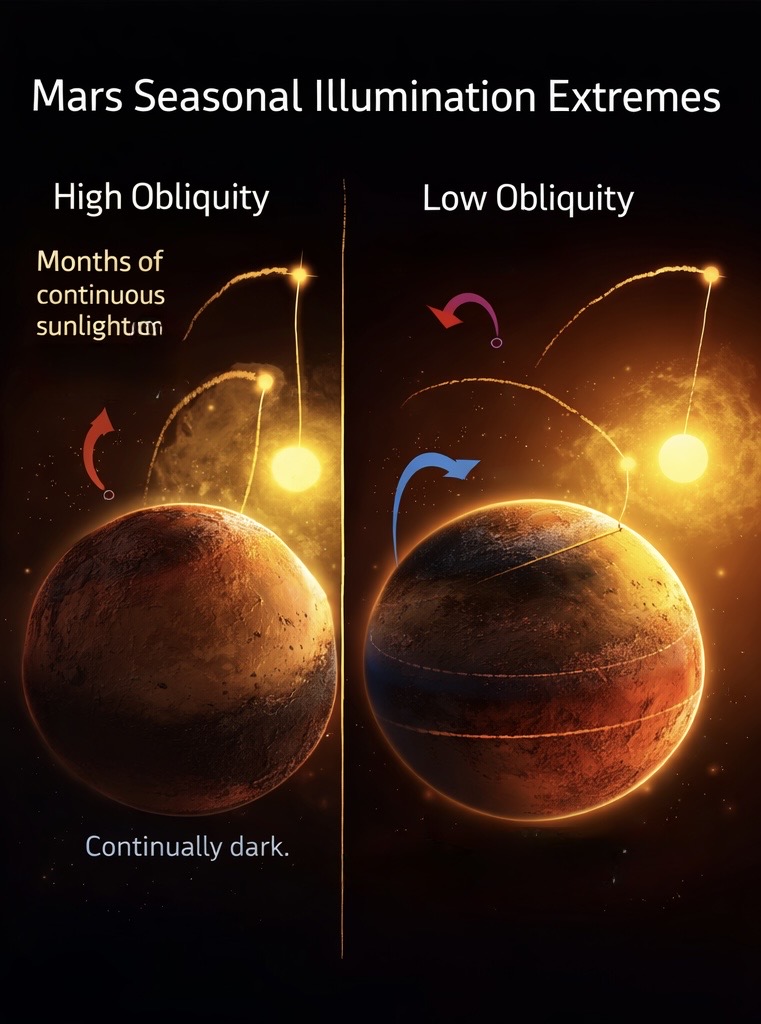
Figure 3: Seasonal illumination extremes demonstrating failure of coherent redistribution.
Closing Statement
Mars is not broken. Mars is what comes next.
Within a Möbius-saturated electromagnetic solar body shaped by Fibonacci growth, Earth represents the first stable equilibrium. Mars represents the first failure to remain there. That failure is not accidental. It is structural. Mars stands as the unstable echo beyond equilibrium, the necessary proof that balance is real, rare and exact.
Produced by The Lilborn Equation Team:
Michael Lilborn-Williams
Daniel Thomas Rouse
Thomas Jackson Barnard
Audrey Williams