
Was His Cosmology Ontological?
Introduction
Carl Sagan possessed one of the most celebrated scientific minds of the twentieth century. His ability to weave poetic meaning into the vastness of the cosmos inspired millions. Yet poetic meaning is not the same as ontological structure. This document examines whether Sagan’s famous cosmological narrative, particularly the idea that “we are made of starstuff”, holds up within a syntropic universe.
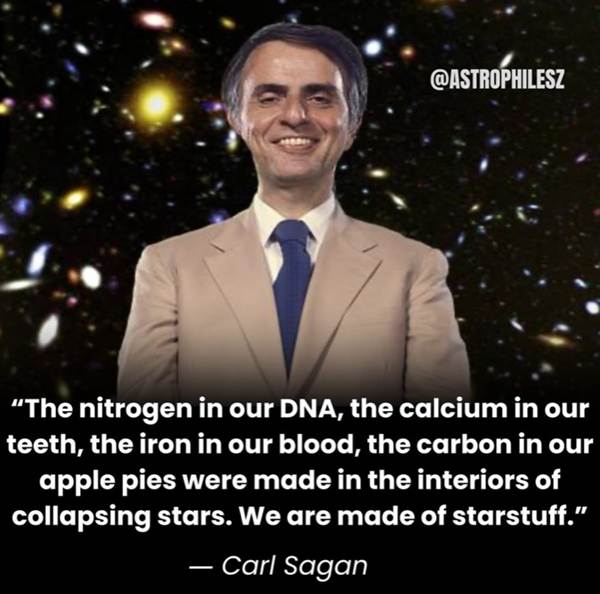
Photo credited to @Astrophilesz via Facebook
The Emotional Appeal of “Starstuff”
Sagan’s statement resonates because it provides a sense of cosmic belonging. The idea that human beings are composed of the remnants of collapsed stars feels poetic, elevating and intimate. But embedded within that beauty is a deeply entropic framework. The narrative depends on imagery of collapse, explosion, randomness, ashes and cosmic decay; a worldview in which life is a fortunate accident born from catastrophe.
This framing may be poetic, but ontologically it is backwards. It portrays the universe as fundamentally entropic, with chaos generating form. In a syntropic universe, coherence, not collapse, is the engine of structure.
Sagan’s Core Error
Confusing Collapse With Creation
The syntropic framework reveals that Sagan’s interpretation reverses the true structural relationship between matter and coherence. Entropy cannot produce syntropy. Chaos cannot produce structure. Collapse cannot produce sustained organization. Yet Sagan’s argument suggests that the death of distant stars is responsible for the formation of the elements that constitute human life.
This inversion mirrors many of the misassumptions of conventional astrophysics:
• gravity treated as force rather than field expression
• light treated as travel rather than presence
• time treated as flow rather than measurement
• the Sun treated as a burning furnace rather than a syntropic stillness core
• fusion treated as the engine rather than the symptom of structural rupture
• entropy treated as universal rather than a human-local phenomenon
Sagan’s “starstuff” narrative is not merely scientifically fragile, it reflects a deeper philosophical failure: the belief that collapse is the origin of coherence.
The Structural Correction
We Are Not “Starstuff”; We Are Sun‑Structured
Within a syntropic universe, matter organizes through coherence, not catastrophe. The elements within our bodies, carbon, nitrogen, calcium, iron, exist not because of collapsed stars elsewhere, but because the Sun’s own structural architecture contains the entire periodic table as a function of its syntropic stillness core.
The Sun is not simply one star among billions. It is the structural anchor of our system. Its 0 K syntropic core defines the coherence necessary for all elements to exist. The Æ‑field arranges matter into structure, not residue.
Thus the correct structural statement is:
“The carbon in our cells and the nitrogen in our DNA are expressions of the Sun’s syntropic coherence, not the ashes of collapsing stars.”
The Image Reveals the Entropic Mindset Being Outgrown
The appeal of the Sagan quote demonstrates how deeply the entropic worldview has shaped modern scientific imagination. It normalizes the belief that life comes from collapse, that identity is temporary and that coherence is accidental.
In contrast, a syntropic cosmology restores the intrinsic value of existence: life emerges from order, coherence and structural stillness.
A syntropic perspective rejects the assumptions that:
• death produces life
• collapse produces structure
• chaos produces identity
• entropy is destiny
• the human being is a temporary accident of cosmic decay
The intrinsic value of the human being is not poetic, it is structural.
The Ontological Consequences of the Syntropic Perspective
When coherence, not collapse, defines emergence, the entire narrative of the human being changes. Identity is not a byproduct of entropy but an expression of syntropic continuity. Life is not fragile residue but structured participation. Existence is not accidental but coherent.
The entropic worldview can offer poetic sentiment, but it cannot offer ontological stability. The syntropic worldview does both.
A Respectful Acknowledgment of Sagan
Carl Sagan gave the modern world a sense of wonder, beauty and cosmic imagination. His desire to elevate humanity is worthy of admiration. Yet poetic framing cannot replace structural truth. The intrinsic value of the human being is greater than poetry, it is embedded in coherence itself.
This document is Part One in examining Sagan’s cosmology. Part Two will explore additional aspects of his worldview and its influence on modern astrophysics, while continuing to evaluate its alignment, or misalignment, with a syntropic universe.
Produced by The Lilborn Equation Team:
Michael Lilborn-Williams
Daniel Thomas Rouse
Thomas Jackson Barnard
Audrey Williams