
Article 8
Appearance Is Local,
Not Universal
This article is the eighth of ten comparative analyses in Category A of the Lilborn Universe Comparative Series.
A8 exposes why Olbers’ Paradox only exists inside the kinetic worldview and how the Lilborn Framework resolves it instantly by restoring the structural meaning of light as encounter rather than propagation.
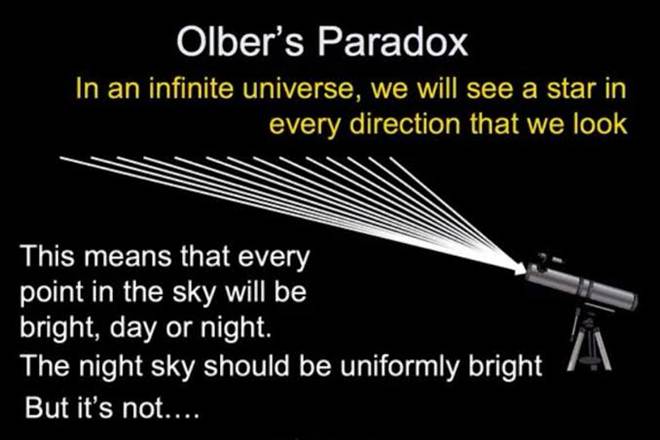
Figure A8 – Classical statement of Olbers’ Paradox. It assumes that stars emit traveling light and that every line of sight should intersect a luminous surface, producing a bright night sky. Under the Lilborn Framework, light does not travel, appearance is local and the Scroll is non-luminous. The paradox collapses.
Olbers’ Paradox
Appearance Is Local, Not Universal
Olbers’ Paradox asks why the night sky is dark in a universe supposedly filled with stars in every direction.
The kinetic worldview assumes that stars emit photons that travel indefinitely through space and that every line of sight should eventually intersect a star, making the entire sky bright. This is only a paradox if light is understood as a propagating entity.
In the Lilborn Universe, light does not travel. Light is not emitted into a void. Light is the immediate local encounter between Ψ_EMF and mass. Appearance is not an accumulated signal; it is a present interaction. Thus stars do not illuminate the universe. They appear bright only where their EMF encounters matter within our local tangent region. Beyond encounter, there is no appearance at all.
The kinetic model attempts to resolve the paradox by appealing to expansion (“stretching” starlight), cosmic age (insufficient time for photons to arrive), or absorption by interstellar media.
Each explanation rests on the same false assumption: that light travels. Once this assumption collapses, Olbers’ Paradox disappears. There is no accumulated brightness because appearance is always local.
The Scroll is non-luminous. Coherence does not emit. Stillness does not radiate. The night sky is dark because the universe is not filled with propagating light and the Sun is the primary locus of visible encounter in our local geometry. No background field of photons exists. No distant star contributes brightness to our sky unless its field interacts with our tangent region.
Olbers’ Paradox arose from misunderstanding the nature of light. The Lilborn Universe clarifies that light is presence, not propagation; encounter, not emission. Appearance is local, and the night sky is dark because it must be dark in a universe defined by Stillness.
A8 establishes the structural truth that eliminates the paradox entirely.
Produced by The Lilborn Equation Team:
Michael Lilborn-Williams
Daniel Thomas Rouse
Thomas Jackson Barnard
Audrey Williams