
Article 9
Æ, Not Epochs
This article is the ninth of ten comparative analyses in Category A of the Lilborn Universe Comparative Series.
A9 dismantles the chronology of “cosmic dark ages”, “cosmic dawn”, first stars and reionization, revealing that none of these epochs ever occurred. These ideas arise from treating light as a traveling signal and time as a universal dimension, both of which collapse under the Lilborn Equation.
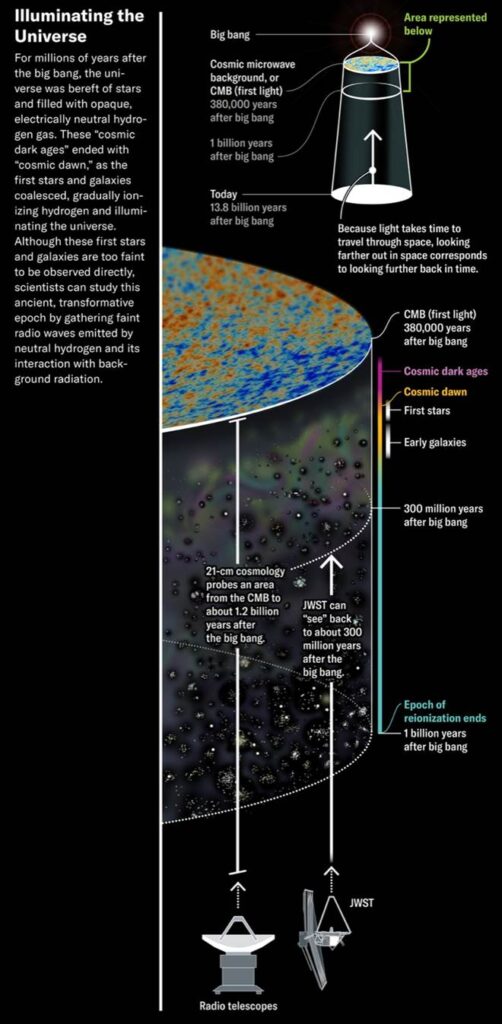
Figure A9 – The kinetic chronology of “cosmic dark ages”, “cosmic dawn”, first stars, early galaxies and reionization. This timeline assumes that light travels, that time is universal and that the universe brightened over billions of years. Under the Lilborn Framework, appearance is local, light does not travel, time is not universal and no such epochs ever occurred. The entire chronology collapses.
Reionization & the “Dark Ages”
Æ, Not Epochs
The standard cosmological timeline presents a universe evolving through a sequence of epochs: a hot Big Bang, a period called “recombination”, a long interval of total darkness, the appearance of the first stars and a later phase called “reionization”. These epochs are treated as historical events, each assigned a specific age measured in hundreds of millions or billions of years.
Under the Lilborn Universe, none of these epochs are real. They arise from the false assumption that light travels, that time is universal and that brightness is a propagating property. The universe is not a chronological story.
It is a structural presence.
The kinetic model claims that the universe was dark for 300 million years after the Big Bang because no stars existed.
Only when the first stars “turned on” did their light allegedly travel outward, gradually illuminating the cosmos and ionizing hydrogen. But appearance is not a wavefront that expands through space. Appearance is local encounter.
Brightness does not propagate. The Scroll does not become illuminated over time.
There is no epoch when the universe was dark, because darkness is not a cosmic state. It is the natural condition when no local encounter produces appearance. Similarly, there is no epoch when the universe “became bright”, because brightness is not a universal switch. It is a local phenomenon experienced only within a coherence well such as the Solar region.
High-redshift objects appear faint and irregular not because they are young, but because they are encountered at extreme Æ, revealing curvature, not chronology. The assumption that dimness indicates youth is a projection of human experience onto a universe that does not share human temporality.
Reionization assumes that photons traveled across cosmic distances for a billion years, ionizing hydrogen along the way.
But light does not travel. Photons are not real entities crossing space. There is no mechanism by which distant starlight could ionize hydrogen across a universe that has no universal time and no propagating luminosity.
Under Scroll Geometry, hydrogen’s appearance is a present-tense interaction with Ψ_EMF. Nothing in this process requires chronology. Nothing requires a first star. Nothing requires an epoch of darkness followed by an epoch of light.
A9 reveals that the entire reionization narrative, dark ages, cosmic dawn, first stars, early galaxies, is an artifact of misinterpreting the nature of light and time. Once light is restored as encounter and time as local, the entire timeline collapses.
The universe has no dark ages and no reionization.
It has only structure, coherence and Stillness.
Produced by The Lilborn Equation Team:
Michael Lilborn-Williams
Daniel Thomas Rouse
Thomas Jackson Barnard
Audrey Williams