
Article 2
This article continues Category C of the Lilborn Universe Comparative Series.
C2 directly addresses the cosmological redshift, widely interpreted as evidence of universal expansion and reveals it to be a structural effect of encounter geometry, not motion.
Under the kinetic worldview, redshift is treated as a Doppler-like stretching of light due to recession.
Under the Lilborn Framework, light does not travel, wavelengths do not stretch and c is not speed.
Redshift is a change in Æ, the Angle of Encounter, as coherence is observed through the curvature of the Scroll.
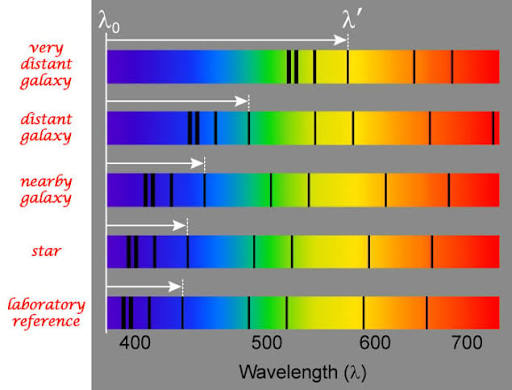
Figure C2 – The conventional interpretation of redshift. This diagram assumes that displacement of spectral lines toward the red end of the visible spectrum corresponds to increased distance. Under the Lilborn Framework, this assumption is a category error. Redshift is structural, not spectral. The appearance of “more red” is not evidence of recession or expansion, but the result of observing coherence through a changing Angle of Encounter (Æ) within Scroll geometry.
Using color to measure distance is like determining how far away people are based on the color of clothing they wear.
People wearing red shirts would always be the farthest away. This is not physics, it is an interpretive mistake.
Color is not distance. Color is encounter.
Redshift, Æ and the Illusion of Expansion
The cosmological redshift has been interpreted for nearly a century as a sign that the universe is expanding.
According to the kinetic model, distant galaxies recede from us, stretching the wavelengths of their emitted light.
This interpretation requires motion, propagation and a medium capable of stretching, space itself.
But the Lilborn Universe operates in Stillness, not motion. Light does not propagate across space; it appears at the encounter point between mass and coherence. Wavelengths do not stretch; color does not travel and c is not velocity.
Therefore, redshift cannot be the result of recession or expansion.
Redshift arises because the observer is encountering distant coherence through regions of varying curvature K(x) and alignment A(x). As the Angle of Encounter (Æ) changes along the Scroll, appearance shifts structurally.
The spectral lines do not move; the geometry of encounter moves. This shift in Æ produces the illusion of a stretched spectrum.
Under the Lilborn Framework redshift does not:
• measure distance
• measure velocity
• measure cosmic time
• imply expansion
• require dark energy
• reveal a younger universe
It reveals only the geometry of encounter, how curvature and coherence shape the appearance of distant structure.
This redefinition collapses every expansion-based construct:
1. Hubble’s law becomes a geometric relation, not a velocity relation.
2. “Lookback time” becomes meaningless.
3. Expansion becomes unnecessary.
4. Accelerated expansion becomes impossible.
5. Dark energy becomes irrelevant.
6. The thermal history of the universe becomes unsupported.
The redshift is a structural fingerprint of the Scroll, not a measurement of cosmic recession.
C2 therefore establishes the second collapse of Category C: redshift is a change in Æ, not a change in wavelength.
It is the structural expression of coherence within Stillness, not evidence of a universe that expands.
Produced by The Lilborn Equation Team:
Michael Lilborn-Williams
Daniel Thomas Rouse
Thomas Jackson Barnard
Audrey Williams