
Article 3
Encounter Geometry,
Not Distance Dimming
This article continues Category C of the Lilborn Universe Comparative Series.
C3 collapses the long‑held assumption that surface brightness decreases because of distance, propagation or expanding space. Under the kinetic worldview, dimming is attributed to the inverse‑square law, photon dilution, wavelength stretching and the Tolman surface brightness test.
Under the Lilborn Framework, light does not travel, space does not expand and c is not a speed.
Brightness changes only because the encounter geometry (Æ) changes as coherence is observed through the curvature of the Scroll.
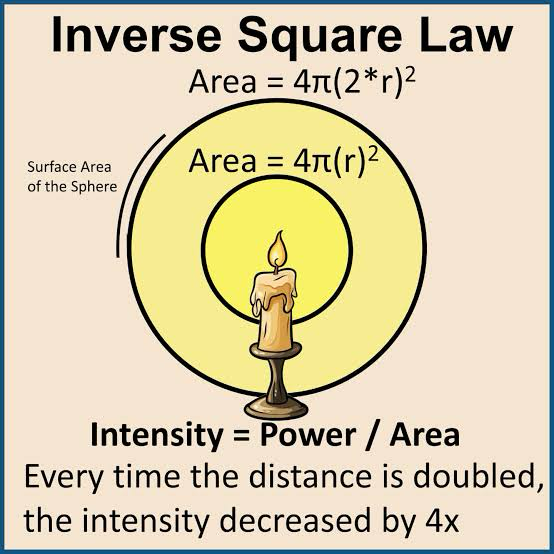
Figure C3 – The classical inverse‑square model assumes that light travels outward from a source, spreads over ever‑larger spherical surfaces and therefore becomes fainter with distance. This picture requires propagation,
photon dilution and expanding area. Under the Lilborn Framework, light does not propagate and appearance does not dilute. Brightness changes only because Æ (the Angle of Encounter) changes. The inverse‑square law is a
geometric artifact of motion‑based thinking, not a description of how appearance works in a universe defined by Stillness.
Using the inverse‑square law to measure cosmic distances is like estimating how far away people are based on the color of shirts they wear, with red shirts assumed to be the farthest. It is not physics. It is a category error.
Brightness is not distance. Brightness is encounter.
Every brightness test ever conducted, including the inverse‑square law, candlepower experiments, flux dilution studies, the Tolman surface brightness test and all laboratory photometry, was performed inside Earth’s atmosphere. The atmosphere introduces scattering, absorption, refraction, diffraction,
pressure gradients, particulates, ionization strata and EMF coupling that do not exist in cosmic Stillness.
To impose atmospheric behavior onto the universe is the same as imposing speed onto light or time onto the Scroll.
The universe knows no speed and knows no time. Atmospheric dimming was mistaken for universal truth.
Surface Brightness & the,
Collapse of Distance Dimming
The Tolman test claims that surface brightness decreases with redshift as (1+z)^{-4}.
This dramatic dimming is interpreted as a verification of expanding space. But the test assumes photon travel, energy loss, time dilation and metric stretching – assumptions that collapse under the Lilborn Universe.
Light does not travel, therefore energy cannot dilute. Space does not expand, therefore area cannot stretch. Time does not flow, therefore arrival rates cannot slow. Photons do not exist, therefore wavelengths do not lengthen. All four components of the Tolman dimming equation are false premises.
Brightness is not a measure of distance. It is a measure of encounter geometry.
Distant galaxies appear fainter not because they are “farther” but because their appearance is encountered through regions of different curvature K(x), tension Ψ_EMF(x), and alignment A(x) on the Scroll. Æ changes and appearance changes with it.
This explains why early galaxies in deep‑field images retain sharp structure, why supposed “young” galaxies look mature, why surface brightness does not fall as rapidly as expansion predicts and why no dimming law built on propagation matches all observations. The Scroll does not send light to us. The Scroll reveals coherence at our encounter point.
Surface brightness dimming is geometric, not dynamical.
C3 establishes the third collapse of Category C: brightness is controlled by encounter, not distance.
The universe does not dim with distance because it does not operate on distance. Appearance is shaped only by the geometry of encounter in a universe defined by Stillness.
Brightness is not distance. Brightness is Æ.
Produced by The Lilborn Equation Team:
Michael Lilborn-Williams
Daniel Thomas Rouse
Thomas Jackson Barnard
Audrey Williams