
Article 4
Absence of Encounter,
Not Blocked Light
This article continues Category C of the Lilborn Universe Comparative Series.
C4 addresses one of the most familiar visual experiences in human life, the shadow, and reveals that the classical explanation is entirely incorrect. The kinetic worldview claims that shadows form because objects block “rays of light” traveling from a source. Under the Lilborn Framework, light does not travel, photons do not propagate and shadows are not created by blocked rays.
A shadow is the absence of encounter: the region where coherence fails to meet mass.
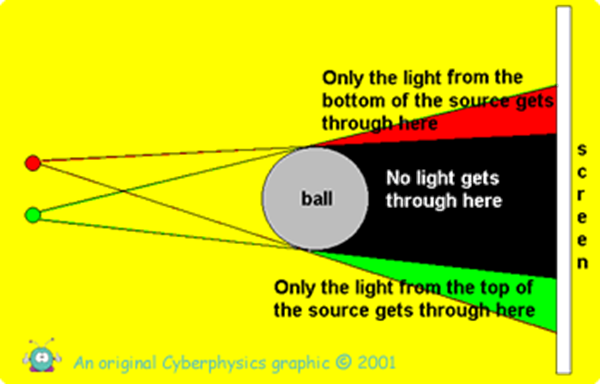
Figure C4 – The classical ray model of shadow formation. This diagram assumes that light leaves a source as directional rays, travels through space and is blocked by an intervening object to create a shadow.
Under the Lilborn Framework, this interpretation is impossible. Light does not travel, photons do not propagate and no ray crosses space. A shadow is not a region where light “fails to arrive.” It is a region where encounter is interrupted, where coherence does not meet mass at the observer’s location.
Shadows
Encounter Interruption,
Not the Blocking of Traveling Light
In the kinetic worldview, a shadow appears because an object blocks traveling photons from reaching the surface behind it. This narrative assumes that light moves, that photons carry energy across space and that darkness is the result of photon starvation. Every part of this explanation depends on motion, propagation, emission, transit and interception.
None of these assumptions hold under the Lilborn Universe.
Light does not propagate. Nothing is emitted and nothing travels. A shadow is not a region deprived of photons.
A shadow is the geometric consequence of an interrupted encounter. The Scroll reveals appearance at the encounter point between coherence and mass. Where that encounter is redirected or withheld, a shadow forms.
When an object moves into alignment with a source and observer, the encounter geometry changes instantly.
Shadows do not form after a delay, as they would if light were actually traveling. The boundary of a shadow appears with no transit time, consistent with encounter, not motion.
Shadow sharpness or softness arises not from partial ray-blocking but from the curvature K(x), tension structure Ψ_EMF and alignment changes A(x) across the object’s boundary. Sharp shadows form where encounter changes abruptly.
Soft shadows form where curvature gradients change gradually. The penumbra and umbra are structural expressions of encounter conditions, not evidence of photon streams.
Shadow movement can exceed the value c without paradox because shadows do not move. They are redefined at new encounter points. The Scroll recalculates appearance instantly at each location of alignment, revealing the complete impossibility of the propagation model.
A shadow proves Stillness.
Shadows demonstrate that appearance is relational, not transmitted. They reveal the geometry of encounter, what the Scroll chooses to show, and what it does not.
The kinetic model treats shadows as evidence for photon movement, when in fact they are evidence for the opposite: the immediate, non-propagating nature of coherence.
C4 establishes the fourth collapse of Category C: shadows are not created by blocked light, but by the interruption of encounter. Light does not fail to arrive, encounter fails to occur. Darkness is not the absence of light; it is the absence of coherence revealed at the observer.
A shadow is not the blocking of illumination. A shadow is the absence of encounter.
Produced by The Lilborn Equation Team:
Michael Lilborn-Williams
Daniel Thomas Rouse
Thomas Jackson Barnard
Audrey Williams