
Triple Proof Pack
This short pack introduces a single principle, the Law of Universal Coherence, and shows how it explains three very different phenomena: tides, atoms and light.
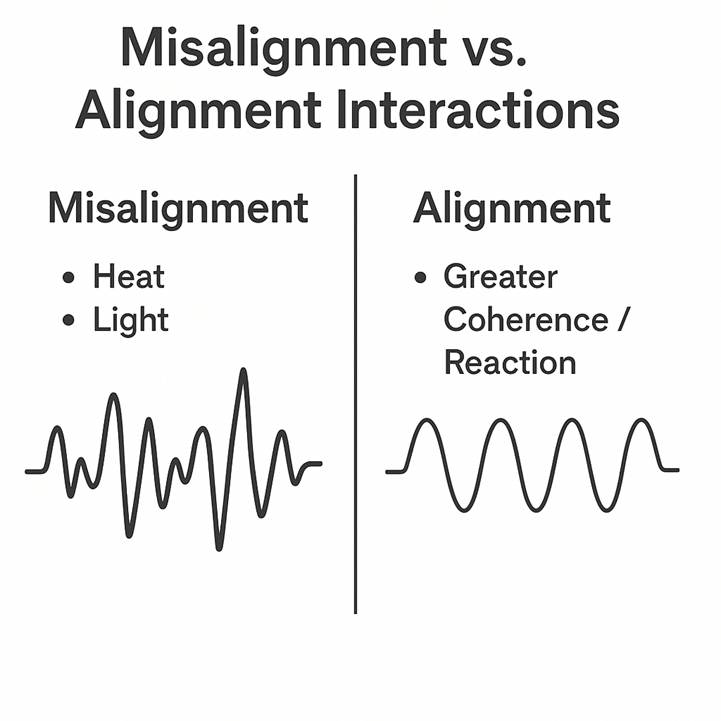
The idea is simple: when oscillations are in alignment, coherence and stability appear. When they are in misalignment, dispersion and decay appear. This law works at every scale we’ve tested.
– Tides: Instead of being pulled by gravity, ocean waters align with electromagnetic harmonics (M2 and S2). The signal is clear and repeatable in real sea-level data.
– Atoms: Instead of requiring a “strong force” to glue the nucleus or “quantized states” to stop electron collapse, stability emerges as coherence, standing-wave alignments within the EMF.
– Light: Instead of particles traveling or waves propagating, light is coherence itself, revealed at the moment of encounter, with alignment producing clarity and misalignment producing heat and scattering.
Each section offers a falsifiable prediction so this isn’t just philosophy. If the tests fail, the framework fails. If they succeed, we’ve unified oceans, atoms and light under one law.
Triple Proof Pack
Tides, Atoms, Light (Newcomer Edition)
Tides
EMF Harmonics in the Sea
Observation: Hourly sea‑level data for Newlyn (1989) show dominant semidiurnal harmonics near 1.93–1.94 cycles/day and 2.00 cycles/day. These correspond to the lunar semidiurnal (M2) and solar semidiurnal (S2) harmonics.
Coherence Explanation: The ocean bulk aligns with planetary EMF harmonics. When the field is in alignment, amplitude and phase of the tide are reinforced; when misaligned, dispersion appears as residual noise.
Falsifiable Signature: Spectral peaks at M2 and S2 must dominate across independent records, and a minimal harmonic model constructed from EMF alignment should overlay the observed tide with superior phase coherence compared with gravitational pull models.
Atoms
Stability as Coherence, not Glue
Observation: Electrons do not collapse into the nucleus, and nuclei with many protons remain stable. Conventional physics uses quantized states and an independent ‘strong force’ to preserve stability.
Coherence Explanation: Electrons are standing‑wave alignments within the EMF, phase‑locked around the nucleus; nuclear constituents are stabilized by coherence minima in EMF mode structures. Radiation and decay occur when misalignment disrupts coherence.
Falsifiable Signatures: (A) Nuclear lifetimes and linewidths change with engineered EMF mode alignment (phase/topology), not only with intensity; (B) Binding energies and low‑lying levels across an isotopic chain cluster along small‑integer standing‑mode bands that enable pre‑registered predictions.
Light
Presence at Encounter
Observation: Light exhibits interference and quantized exchange at emission/encounter, but no direct observation of a discrete carrier in transit.
Coherence Explanation: Light is the direct presence of EMF coherence at the point of encounter. Alignment yields visibility and pattern; misalignment yields dispersion and heat. Light is not a particle moving through space, nor a wave that propagates as a substance; it is the signature of coherent alignment revealed in interaction.
Falsifiable Signatures: (A) Experiments will continue to register only emission/absorption events, never a carrier in transit; (B) Attempts to measure a one‑way speed will reduce to synchronization artifacts, while alignment‑based timing reveals phase‑structured dependencies.
Alignment vs. Misalignment Interactions
Notes on Language and Replication
• “Light” is described as presence and encounter; statements implying “travel” are avoided.
• The discrete carrier term is not used; exchange is described as coherent interaction.
• Replication: The tidal analysis can be reproduced with any hourly sea‑level year; the atomic tests are laid out as binary experiments; the light claims are framed as alignment‑dependent timing rather than transport.
Produced by The Lilborn Equation Team:
Michael Lilborn-Williams
Daniel Thomas Rouse
Thomas Jackson Barnard
Audrey Williams